
Rural Homes Shortage
Whilst there is growing concern in France on recent increases in mortgage interest rates (but still only around 2.5%), similar worries are also being expressed about the lack of properties for sale.
As we have reported previously on these pages, the post-Covid real estate geography of France has changed significantly, with a marked shift in favour of rurality over metropolis.
A combination of low interest rates and the health crisis has been enough to push many French nationals to either relocate to the countryside or to buy a second home where they might be able to live on a semi-permanent basis.
Over the past 2 years, demand for houses has taken off. At the end of 2021, the notaires recorded almost 1.180 million housing transactions over the whole year. By comparison, there were 1.024 million sales in 2020, and 1.067 million in 2019.
The result has been a significant reduction in the supply of country properties, with a consequential increase in prices.
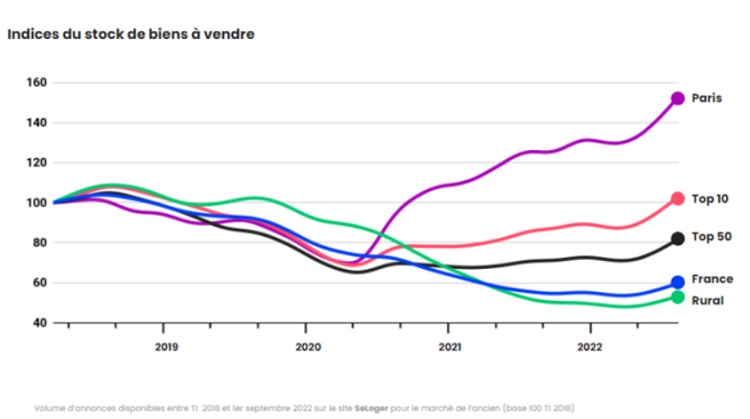
The graphic below shows the trend since 2018 in the number of properties on the market for sale in several metropolitan areas of France, as well as rural locations. It shows that over the past 4 years the number of houses for sale has fallen by -54%, whilst there has been a -28% fall in the number of apartments for sale.
At a national level this shortage has stabilised, but the total number of properties on the market remains very low, as shown in blue on the graphic, with the fall in rural properties in green.
The study, carried out by market analysts Meilleuragents, provides no analysis by region, but in a separate study by 'Bien Ici', a national portal for the sale of properties, shows that the pattern is not the same across the country. Worst affected have been Provence-Alpes-Côte d'Azur, Occitanie and Bourgogne Franche Comté, whilst in the Nouvelle Aquitaine, Centre-Val de Loire and Brittany there has been a small increase in properties for sale. Nevertheless, their figures do not distinguish between apartments and houses and our own sources indicate that right across the country there is a general shortage of houses in the countryside for sale.
As can also be seen from the graphic, the number of properties for sale in Paris has exploded, up 52% since 2018.
Many other larger towns and cities (Top 10/50) have also seen a growth in the number of properties for sale, such as in Toulouse, Nantes, and Bordeaux.
Once again, however, it is not a uniform picture as the agents report that in several major cities, the level of the available stock for sale has shrunk, notably in Marseille, Montpellier, and Grenoble.
Although it is too early to be certain, some commentators in France point to the influence of recent changes in the law on energy efficiency for the increase in the availability of properties for sale in metropolitan areas, particularly in Paris. As we have previously reported, landlords whose properties have a low energy rating cannot increase rents and from January 2023 the least energy efficient cannot be used for letting.
Barbara Castillo Rico, Head of Economic Studies at SeLoger comments that: "While it seems likely that the rise in rates should lead to a decline in demand in the coming months, the situation of properties for sale, observed at the national level, should cushion a potential slowdown in prices."
This should be especially true for markets that have become attractive post-Covid: namely rural properties and most medium-sized cities. Conversely, markets in oversupply (Paris in particular) are very vulnerable markets and will see their prices fall. Earlier this month the national estate agents chain Century 21 reported a fall in properties prices in Paris of nearly -6% since January.
Related Reading: