
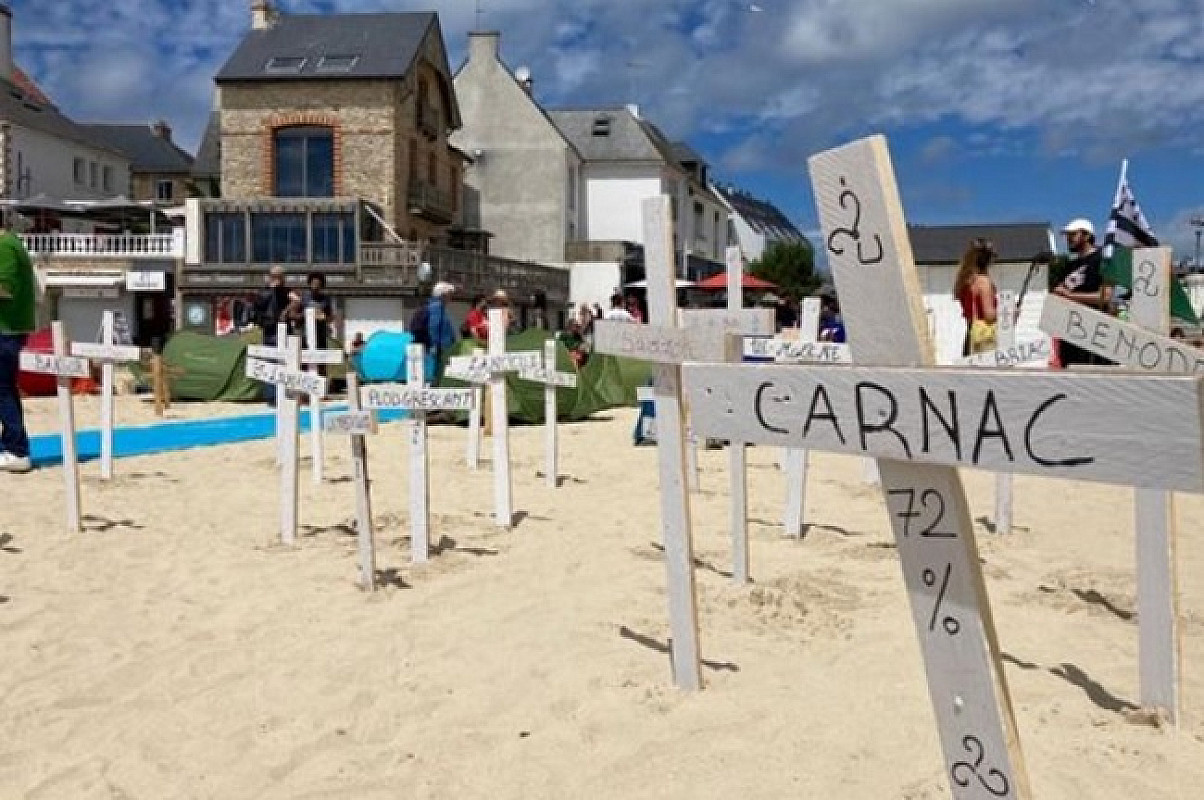
Earlier this month dozens of protesters held a demonstration in the tourist hotspot of Quiberon (Morbihan) to highlight the 'housing crisis' in Brittany.
One of their demands is that Brittany be classed as an area of housing stress ('zone tendue'), when second home owners could then be subject to a surtax on their local rates of up to 60%. Some separatist groups are also demanding that a 'residents only' policy be introduced on the purchase of second homes.
Mainstream politicians have also weighed in on the debate, with the regional council in particular having asked the government for more powers to control the local housing market and Airbnb type lettings.
However, the president of the regional council, Loïg Chesnais-Girard, has criticised the demand for a 'residents only' policy stating that: "Beyond its feasibility, which is largely doubtful in the current state of national and European law, this status would be dangerous, ineffective and contrary to Brittany, its interests and its values."
It is not the first time that there have been demonstrations against the number of second homes in the department, which are in part being fueled by the rise in house prices.
According the the notaires in Brittany, house prices in the year to June 2022 have risen by +7.1% in Côtes-d’Armor, +12,6% in Finistère, +11,4% in Ille-et-Vilaine, and +10,0% in Morbihan and Loire-Atantique. They also report that prices for apartments in Morbihan have rise 18% in a year.
The town of Quiberon is on a peninsula, almost an island to the south of the region, where two-thirds of the housing stock are second homes.
As part of the demonstration the protesters planted funerary crosses, to symbolise the death of resort towns after the summer season, with names of the towns on the crosses.
On a regional level, 12% of the housing stock in Brittany are second homes, compared to 14.5% in Provence-Alpes-Côte-d'Azur and 13.5% in Occitanie, two other popular tourist regions.
However, along many coastal towns in Brittany the percentage can often be well over 50% of the stock.
The popular department of Morbihan has been most affected by this phenomenon, with several towns where the number of second homes is over 70% of the total stock. They are Arzon, Carnac, Damgan, Hoëdic, Île-aux-Moines, Île-d'Arz, Pénestin and Saint-Gildas-de-Rhuys.
Other resorts elsewhere in the region over the 70% threshold are Île-Tudy (Finistère) and Île-de-Bréhat (Côtes-d'Armor).
Although most of the speculation is that these homes are owned by Parisiens and foreign nationals, in fact data from the notaries of France, shows that nearly half (46%) of the owners of the holiday homes in Morbihan actually live in the department. Some 18% come from the Île-de-France and 24% from other French regions.
That trend is confirmed in Finistère (61%), Ille-et-Vilaine (59%) and Côtes-d'Armor (45%), where second home owners come mainly from the department where they live year-round.
Those 41 towns and villages where more than 60% of the housing stock are second homes are as follows, most of which are located on the coast.
Towns and villages with between 50% to 60% of second homes are: Saint-Briac (Ille-et-Vilaine) 60%, Fréhel (Côtes d’Armor) 59.9%, Saint-Lunaire (Ille-et-Vilaine) 59.7%, Lancieux (Côtes d’Armor) 59.2%, Locmariaquer (Morbihan) 59%, Sauzon (Belle-Ile) 59%, Sarzeau (Morbihan) 57.7%, Erquy (Côtes d’Armor) 56.7%, Pléneuf-Val-André (Côtes d’Armor) 55.9%, Bénodet (Finistère) 54.6%, Larmor Baden (Morbihan) 54.4%, Ile de Groix (Morbihan) 52.4%, Locquirec (Finistère) 52.2%, Gâvres (Morbihan) 52.1%, Roscanvel (Finistère) 51.9%, Trévou-Trévignec (Côtes d’Armor) 51.3%, Saint-Quay-Portrieux (Côtes d’Armor) 50.5%, and Plougrescant (Côtes d’Armor) 50.3%.
Interestingly, although the town of Saint Malo is the most popular tourist destination in the region, only 26% of the housing stock in the town are second homes.
| Arzon (Morbihan) | 77.2% |
| Saint-Gildas-de-Rhuys (Morbihan) | 77% |
| Ile de Hoëdic (Morbihan) | 75.5% |
| Damgan (Morbihan) | 74.1% |
| Ile aux Moines (Morbihan) | 72.4% |
| Ile d’Arz (Morbihan) | 72.2% |
| Ile de Bréhat (Côtes d’Armor) | 72.1% |
| Carnac (Morbihan) | 71.4% |
| Plénestin (Morbihan) | 71.1% |
| Ile Tudy (Finistère) | 70.8% |
| Ile de Molène (Finistère) | 68.9% |
| Locmaria (Belle-Ile) | 68.8% |
| La Trinité-sur-Mer (Morbihan) | 67.7% |
| Le Mont Saint-Michel (Manche) | 67.1% |
| Saint-Pierre-de-Quiberon (Morbihan) | 66.5% |
| Saint-Cast-le-Guildo (Côtes d’Armor) | 66.4% |
| Quiberon (Morbihan) | 66.2% |
| Ile de Batz (Finistère) | 64.5% |
| Saint-Jacut-de-la-Mer (Côtes d’Armor) | 63.4% |
| Ile de Houat (Morbihan) | 62.6% |
| Bangor (Belle-Ile) | 61.9% |
| Saint-Philibert (Morbihan) | 61.3% |
| Saint-Nic (Finistère) | 60.4% |
Related Reading: