

France’s private rental market tightened further in 2025, with rents rising across most of the country while the number of available properties continued to decline, according to a major review of the market published last month.
The annual review by CLAMEUR, an independent observatory for the unfurnished private sector rental market, is based on millions of lease records, and offers a unique insight into the market.
Supply
CLAMEUR report that one of the most striking structural trends is the contraction in supply.
They estimate that 3.2% of rental stock disappeared annually between 2016 and 2019, which accelerated to 5.64% per year between 2020 and 2022. Since 2023, the decline has stabilised, but has not been reversed
This loss of supply has not been compensated by new rental investment, creating a persistent shortage of available housing.
The report links this trend to a combination of regulatory pressure (rent controls, energy standards) and economic factors. The result is what CLAMEUR describes as a gradual disengagement of private landlords, some of whom are exiting the market altogether.
The government appear to have taken note of growing shortage in supply, with a recent announcement that the ban on letting G energy rated properties will be lifted, on condition that the a landlord commits to upgrading the property within 3 to 5 years. The details of the measure are awaited, including just how such works might be accomplished with a tenant in situ!
Rents
Against this backdrop of shrinking supply, rents rose by an average of +2.1% in 2025, continuing a steady upward trajectory.
Rents increased in almost all French departments. Only a handful of areas (including rural or less dynamic areas) recorded declines.
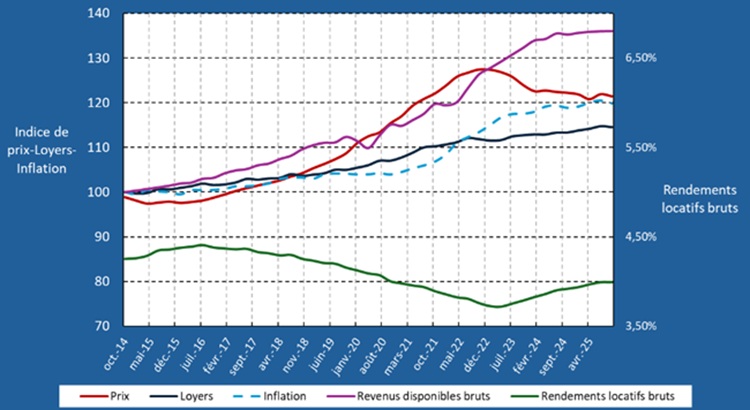
Over the past 11 years, whilst rents have increased on average by +14.5%, prices have increased by an average of +21.4%. Overall, rental yields have fallen by -0.25%, as shown on the following graphic.
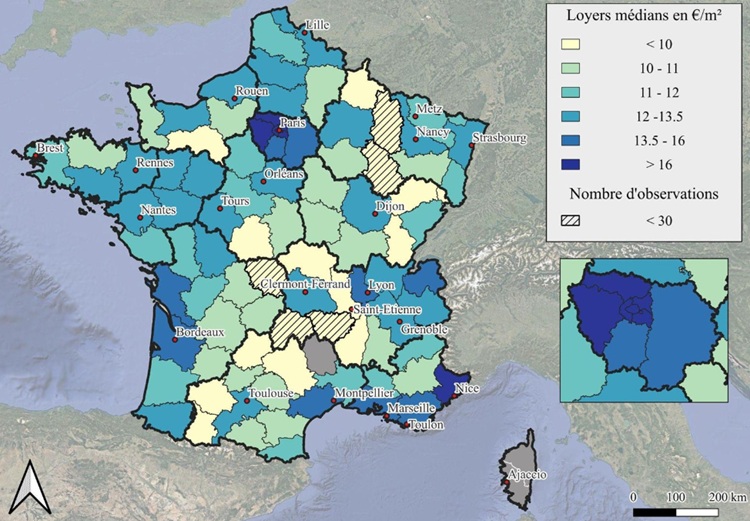
Beyond averages, CLAMEUR’s data highlight extreme disparities in rent levels across France ranging from around €7.60/m² for apartments in the least expensive departments up to an average of €29.80/m² in Paris. Rents are around €17.90/m² in Alpes-Maritimes and €15–16/m² in dense urban departments
Even within major cities, disparities remain significant. Thus, in Paris they are around €25/m² in more affordable neighbourhoods, but up to €39/m² in central districts.
The following graphic shows the departmental rental averages.
A more detailed source of information on rental levels can be found at cartes des loyers.
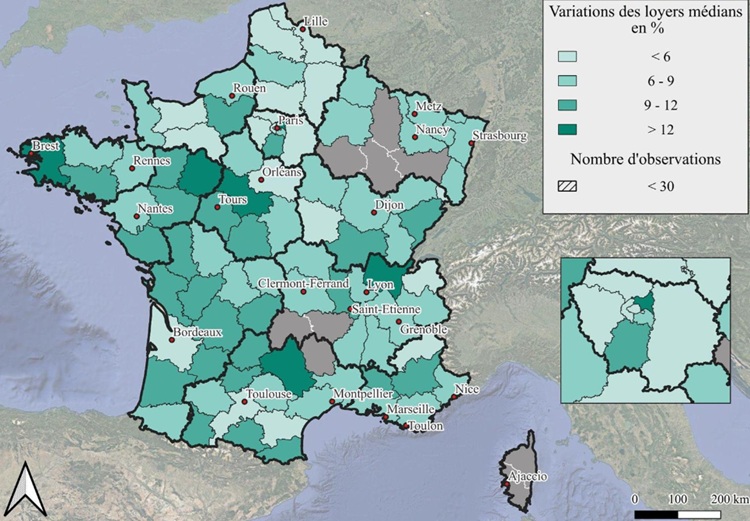
While large metropolitan areas remain the most expensive, the strongest rent increases are no longer confined to them. Between 2024 and 2025 some departments recorded increases above +6% or even +7%, whilst others saw declines of up to -5%, though these remain exceptions.
Over a longer period (2020–2025) some territories saw cumulative increases exceeding +25%, whilst others, including dense urban areas, experienced very limited growth (around +1%)
CLAMEUR state this reflects a redistribution of rental pressure with slower growth in already expensive urban cores and faster growth in smaller cities and peripheral areas
The following graphic show the percentage average increase in rents by department for the period 2020-25.
Profitability
The report also highlights declining attractiveness for landlords in prime areas.
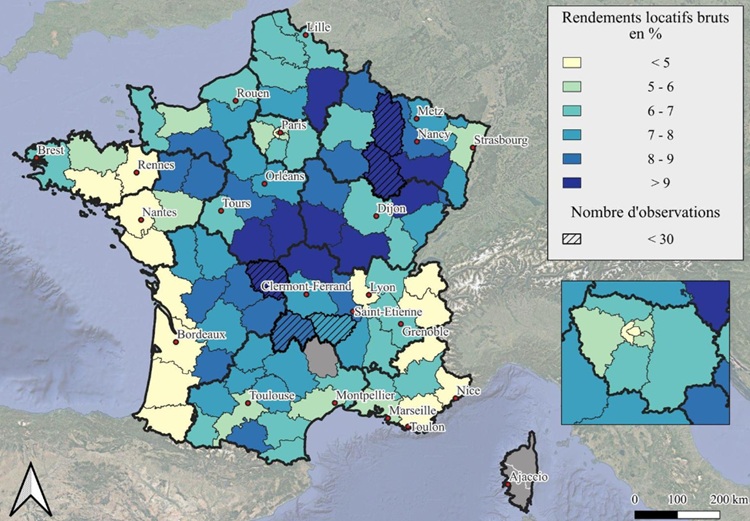
Gross rental yields in 2025 show sharp contrasts, with around 3.5% in Paris but to 10–11% in some rural departments
This gap reflects a key structural imbalance, where in high-demand areas, prices are high but yields are low. In lower-demand areas, yields are higher but demand is weaker.
The following graphic shows the average yield by department for 2025.
Rent controls
Although rental controls exists in areas of housing stress, CLAMEUR state that rent control policies in cities such as Paris, Lyon and Lille have had no statistically significant impact on rent levels.
This directly contradicts findings from the another recent report from the Atelier parisien d'urbanisme, which estimates that rent caps have reduced rents by about -5% in regulated cities.
Related Reading: