
The report from the Notaires de France highlights that what was once a technical detail at the bottom of a listing has become a decisive factor for buyers, sellers and investors.
The notaires state that after three turbulent years, the volume of transactions for existing homes climbed to around 921,000 by the end of September, marking an 11% year-on-year increase. Prices have stabilised or inched upward, yet beneath these overall improvements lies a growing divide between energy-efficient properties and those that consume more energy.
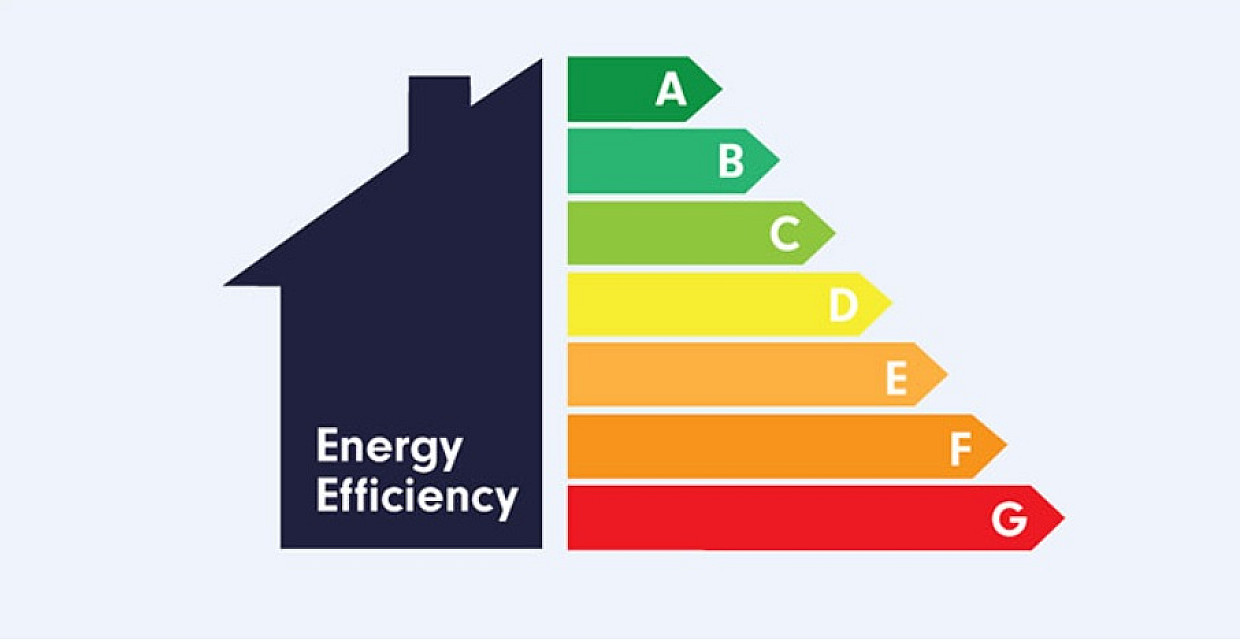
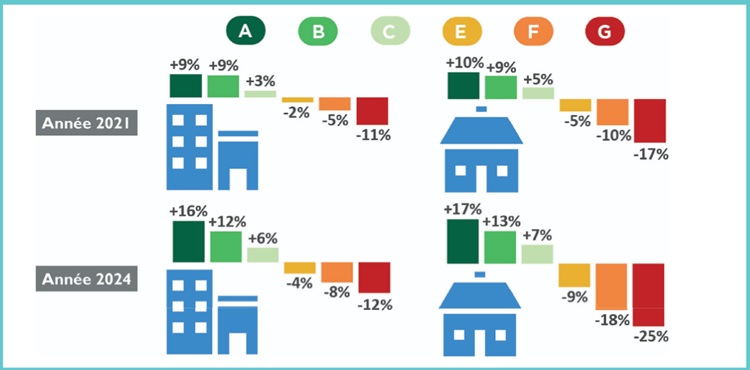
The graphic below shows the influence of the energy ratings, using the energy rating ‘D’ as the reference figure.
It shows that in 2024 a house with a ‘G’ energy rating sold for 25% less than a property with a ‘D’ rating, assuming other factors were the same. The difference was 17% in 2021. In contrast, the sale price of houses with an ‘A’ rating was 17% higher than those with a ‘D’ rating; the difference in 2021 was 10%.
For apartments the difference over the years has not been so large - 12% less for a ‘G’ rated property in 2024 compared to 11% in 2021. However, last year the sale price of apartments with an ‘A’ was 16% higher than those with a D rating; the difference was 9% in 2021.
The notaires state that buyer behaviour reflects this shift clearly. The once-dominant D category has been declining in market share, while C-rated homes have risen to become the second most purchased category.
Conversely, the least efficient properties are increasingly avoided, their appeal diminished not only by higher operating costs but also by recent regulations, such as the gradual prohibition of renting the worst-performing homes, which have eroded their attractiveness and raised concerns about compulsory renovation work.
The notaires consider that for many property owners, improving insulation or upgrading heating systems has become not just an ecological gesture but a necessity to preserve asset value. Buyers, for their part, increasingly approach the market with energy performance as a primary filter, favouring “turnkey”, low-consumption homes that promise stability and comfort.
Related Reading: