

After a fall in 2022, the volume of transactions continued going south in 2023.
The French estate agent's association, FNAIM, estimates that 875,000 sales were concluded, a drop of 22%, compared to 1,115,000 sales in 2022.
The graphic below shows the trend in sales of existing property since 2017.
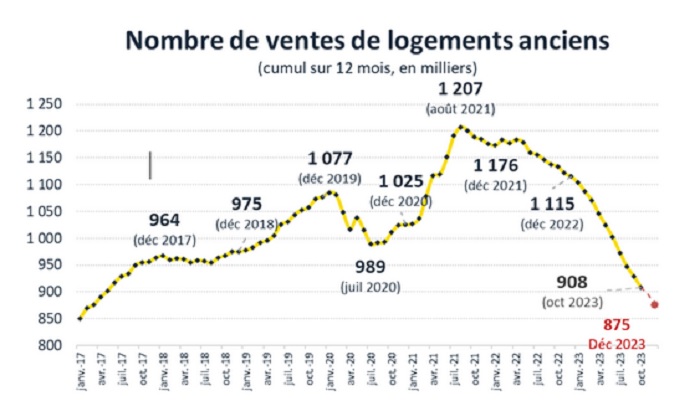
This is the biggest fall in the last 50 years, with 240,000 fewer sales over a rolling 12-month period.
The marked slowdown can be explained by the combined effects of inflation, rising rates and increasing difficulties in accessing mortgages finance: the French have lost 15% of real estate purchasing power in 2 years.
As always, the picture varies across the country.
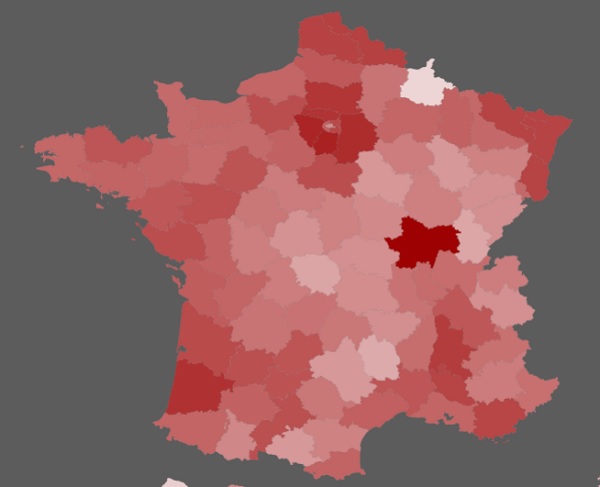
The largest fall (-27.1%) occurred in Saône-et-Loire (Bourgogne-Franche-Comté). Sales also fell by more than -20% in the departments of the Ile-de-France, as well as in many provincial departments, notably the Landes (Nouvelle-Aquitaine) where they fell by -22.3%, Drôme (Auvergne-Rhône-Alpes) -22.3%, Pas-de-Calais (Hauts-de-France) -20.7%, and Var (Provence-Alpes-Côte d'Azur) -20.3%.
More modest falls were recorded in Ardennes (Grand Est) -5.9%, Creuse (Nouvelle-Aquitaine) -10.8%, Lozère (Occitanie) -10.3%, Ariège (Occitanie) -12.1%, Savoie (Auvergne-Rhône-Alpes) -12.9%, and Hautes-Pyrénées (Occitanie) -13.8%. Interestingly, all are predominantly mountainous areas.
The cartographic representation of the fall in sales by department is shown below, with highest falls in those areas coloured deep red.
FNAIM are shy about making any significant statement about prices in 2023; we await the conclusions of the notaires in due course. However, as we reported below, house prices to the end of Q3/23 were down -1.6% on a national basis.