
According to FNAIM, the national association of estate agents, sales in Savoie fell by -12.1%, whilst in Haute-Savoie they fell by -14.6%.
Inevitably, the lower sales was reflected in property prices, but only to a marginal extent. The average fall was only -0.3% in Savoie and -0.7% in Haute-Savoie.
Last year, prices fell by -1.7% in Savoie and -3.6% in Haute-Savoie. However, over the past 5 years prices have increased by +21.% in Savoie and +17.5% in Haute-Savoie.
The FNAIM report provides no details of price movements in the individual ski stations, information which is more likely to be available when the notaires publish their own review in due course.
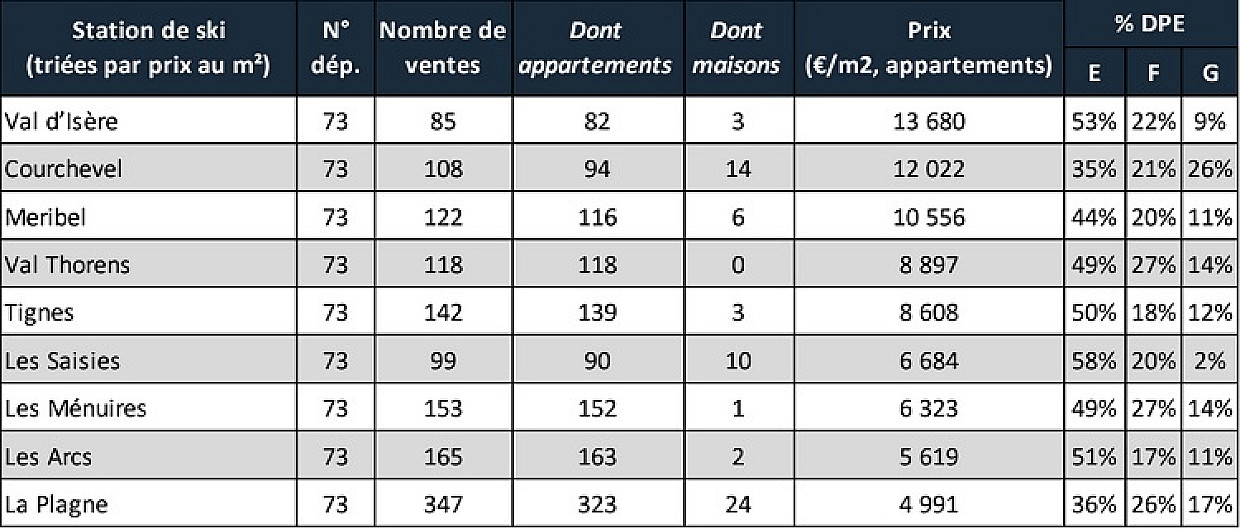
However, the tables below show average prices in the top twenty stations by price in Savoie and in Haute-Savoie.
Val d'Isère (Savoie) retains its title of the most expensive resort, with prices averaging €13,680/m² for apartments. Courchevel, Méribel and Megève follow with prices above €10,000/m². For chalets, prices can exceed €20,000/m², especially in luxury resorts.
Savoie
Haute-Savoie
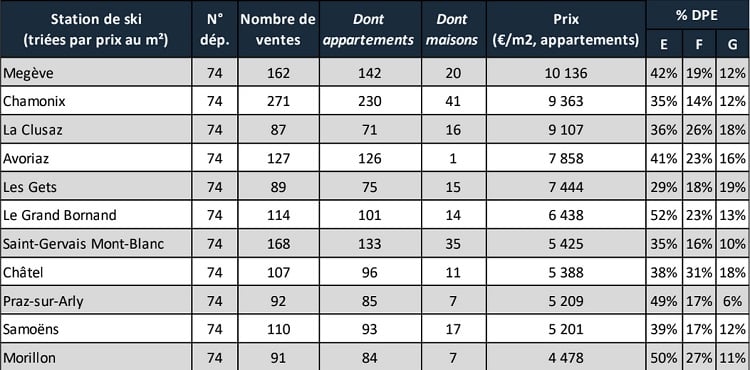
The tables also show the percentage number of properties in each station with low energy efficiency ratings. Since 1st Jan, those properties classed 'G' are classed as 'indecent' and can no longer be used for letting purposes. In 2028, the same rule will apply to 'F' classed properties and in 2034 to those properties with an 'E' classification.
Accordingly, by 2034, without renovation, almost two-thirds of properties could be prohibited for rental, posing a major challenge for the owners and local councils.
The same law also introduced new powers for local councils to control the number of tourist properties in their area, due to the growing tension between second homes and primary homes.
It remains to be seen what effect this will have in the ski stations, although it is bound to vary as many stations are merely holiday complexes. However, it is noteworthy that the local council of Chamonix Mont-Blanc adopted in July 2024 a new regulation to reduce tourist rentals. This measure, which will enter into force in May, concerns the municipalities of Chamonix-Mont-Blanc, Les Houches, Servoz and Vallorcine. Its objective is to counter the rise in house prices and the shortage of housing for permanent residents.
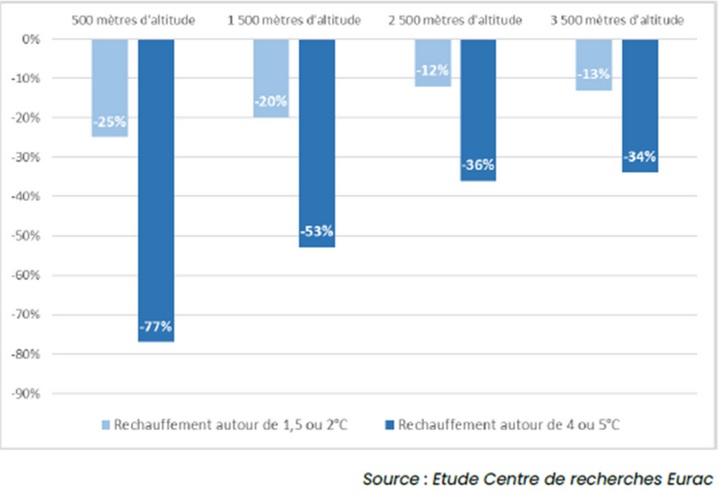
Global warming is also threatening low-altitude stations, with some having closed up shop for skiing. As a result, many low-altitude ski stations are gradually replacing skiing by other activities, whilst those at higher altitude are considering limiting the number of skiers, particularly at weekends.
The graphic below, from an Alpine research centre, shows the potential reduction in snow at different levels of altitude. Thus, at 1500 metres, with an increase in temperature up to +2°C in the Alps around 20% of the snow will disappear. Up to +5°C around half will be lost.