
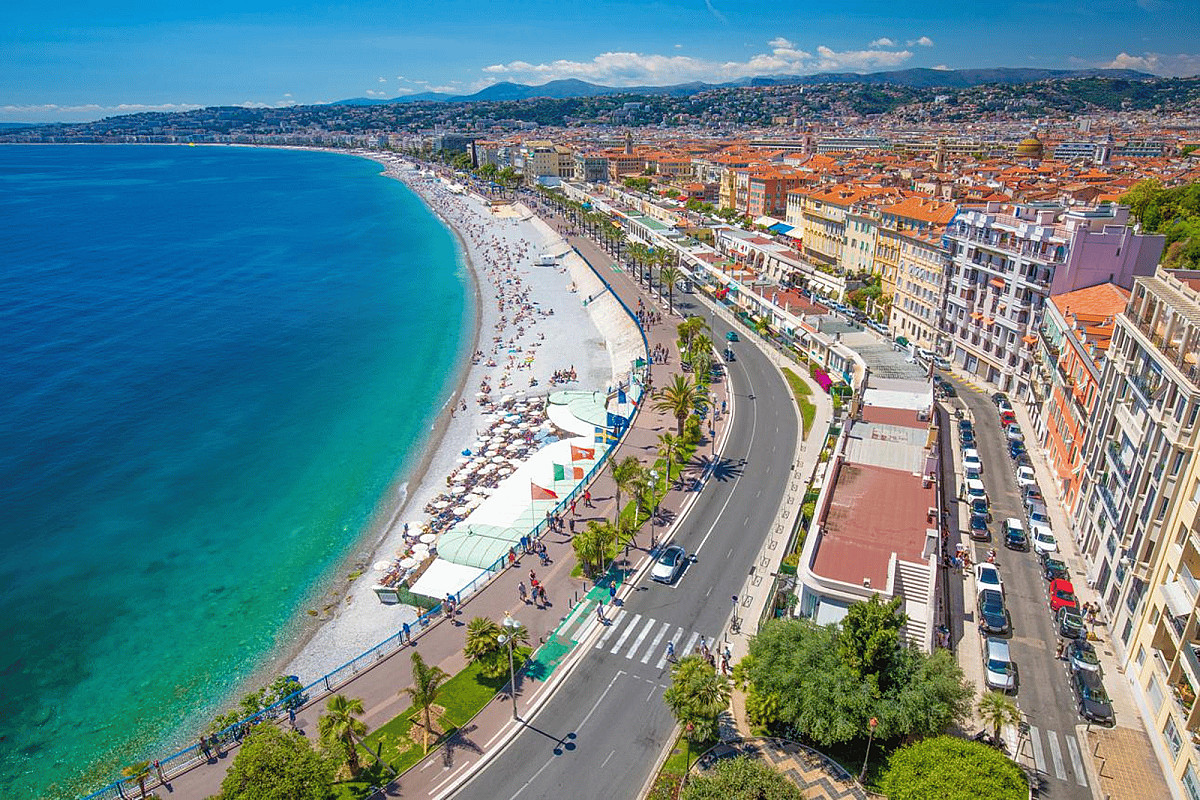
Agents and notaires report that beneath the postcard image of the French Riviera, Nice’s housing market is undergoing a more interesting transformation.
Prices have continued to rise, but the number of sales has been much less consistent, while buyers increasingly look beyond the city itself in search of more space and better value.
According to FNAIM, the national association of estate agents, the average price in Nice reached €5,515 per square metre in June 2026, up 4.7% over the previous year and 23.9% over three years. That was the second strongest three-year performance among the major French cities tracked by FNAIM, behind Quimper (Brittany) at 25.7%.
With prices rising at this rate, affordability has become a constraint for many (particularly first-time) buyers, and transaction volumes have struggled to regain their earlier levels.
According to government figures, there were 7,803 sales in 2025, 6,756 in 2024 and 7,820 in 2023. The high point was in 2022, when 9,711 sales were recorded.
FNAIM recorded 7,740 transactions in Nice over the 12 months to June 2026.
Prices vary considerably between neighbourhoods:
Cimiez — €5,448/m²
Fabron — €5,419/m²
Libération — €4,661/m²
Riquier–Saint-Roch — €3,822/m²
Source: PAP, June 2026.
Cimiez, with its Belle Époque buildings and established residential character, continues to attract affluent families and retirees. Fabron combines relatively modern housing with access to both the airport and city centre.
Libération has become increasingly attractive to investors. Its proximity to the railway station and tramway, together with demand from students and young professionals, supports the rental market. Jessica Lhomme, from PAP, describes it as “the ideal district for an investor looking for good rental returns without taking excessive risks.”
Further east, Riquier–Saint-Roch offers a very different proposition. At under €3,900/m², it remains one of Nice’s more affordable major districts and is benefiting from redevelopment.
Beyond Nice
For many households, however, the attraction of Nice is increasingly being balanced against the cost of buying there.
PAP’s figures show a growing ring of communes where buyers can obtain substantially more space while remaining within easy reach of the city.
Saint-Laurent-du-Var — €4,674/m²
Falicon — €4,315/m²
Saint-André-de-la-Roche — €3,910/m²
Gattières — €3,775/m²
Drap — €3,650/m²
Cantaron — €3,643/m²
La Trinité — €3,460/m²
The difference can be substantial. At these average prices, a 90m² family apartment in La Trinité rather than Nice represents a difference of around €150,000.
Foreign Buyers
Foreign purchasers remain an important part of the market, particularly in the Carré d’Or, along the Promenade des Anglais, in Mont Boron, the Port and other eastern parts of the city.
Benjamin Mondou of Century 21 is particularly emphatic about their importance: “This foreign clientele is driving the Nice property market.” He says international buyers typically have substantial purchasing power and tend to seek properties in excellent condition, with good amenities, outside space and sea views.
An important difference is their reliance on finance. Many foreign purchasers buy without a mortgage, meaning that they were less affected by the sharp rise in French borrowing costs during 2023 and 2024.
As Mondou puts it, “Even during the years of crisis and rising borrowing costs, in 2023 and 2024, the momentum did not break.”
The foreign market is also becoming more diverse. Agents report increasing numbers of South American, South African and Chinese purchasers, alongside the more established international clientele.
There is also a significant Parisian presence. Nadège Breuzard, from agents Nestenn, describes Nice as “the second Parisian suburb” — an indication of how the city has become attractive not only to foreign buyers but also to wealthy households from the capital.
The market is consequently highly segmented.
International buyers tend to favour central and eastern districts where they can walk to the sea, shops and restaurants. Families living and working locally are more likely to look towards the west, where larger apartment developments and residential complexes offer more space.
The distinction is also architectural. The east has a more urban, walkable character, while the west offers more closed developments, often with swimming pools and tennis courts.
The market itself extends well beyond Nice’s administrative boundaries, with the effective property market running from Villeneuve-Loubet in the west to Villefranche-sur-Mer in the east.
Development Constraints
One of the strongest arguments for Nice’s resilience is simply the difficulty of adding new housing.
“We can no longer build,” says Mondou. “The market is frozen, with very little land available. Consequently, we have little stock for sale.”
According to the Côte d'Azur's Observatoire Immobilier d'Habitat, in a report published jointly with the Chambre des Notaires des Alpes-Maritimes in March 2026, available new-build housing stock across the department had fallen to just 1,833 units by the end of 2025, a shortage compounded by building permits collapsing to under 3,400 authorisations that year, against a pre-Covid average of roughly 7,000.
The shortage helps explain why prices have remained relatively resilient even when higher borrowing costs have reduced the number of buyers able to transact.
Nevertheless, the picture is not entirely one of uninterrupted growth.
Olivier Pescheux of Concept Patrimoine says his business had been performing well during the first part of 2026, but has recently seen a modest slowdown. Turnover was running around 5–6% behind the previous year, with fewer active buyers and greater caution linked to economic and political uncertainty and the summer period.
He does not, however, see this as a change in the underlying market.
“The market is broadly stable,” he says, pointing to the fall in borrowing costs over the previous two years, which restored some purchasing power to local buyers and made negotiations easier.
That may soon change, however, as mortgage rates have begun to rise again. This month, CAFPI, the leading mortgage broker, reported average rates of 3.43% on 20-year loans and 3.53% on 25-year loans, after several months of relative stability.
Stéphane Paolino, from the Chambre de Notaires de Alpes Maritimes, stated recently that the market had entered "a phase of stabilisation," with sales holding and prices in a “controlled progression”.
Nice’s market may, therefore, pause, but the forces supporting it remain unusually strong: restricted land supply, substantial foreign demand, a large investor market, year-round employment and tourism, and a rental market under considerable pressure.
Related Reading: