
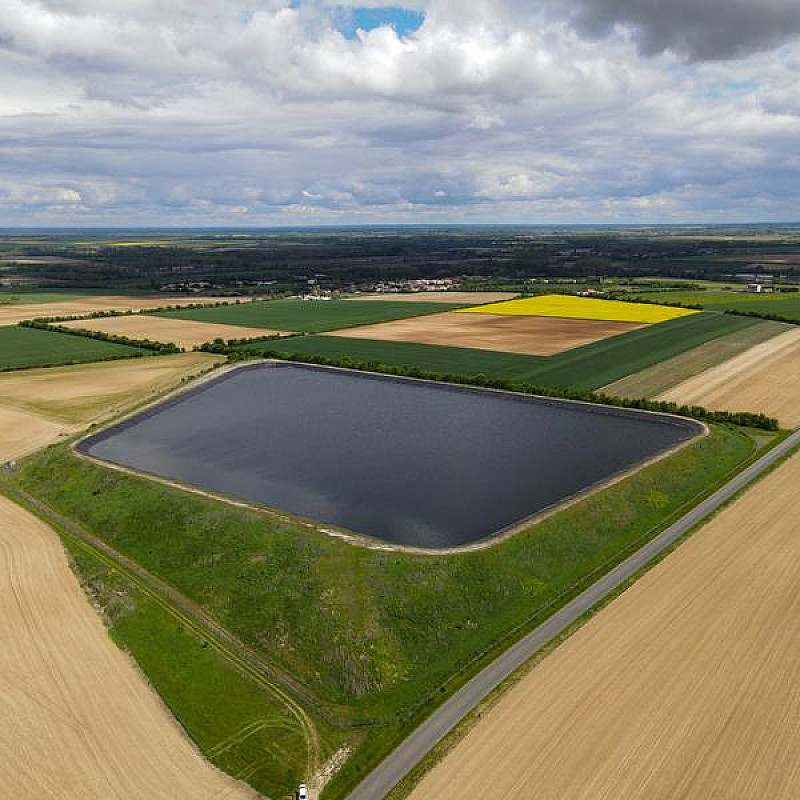
A French court has ordered the destruction of four controversial ‘méga-bassines’ in Charente- Maritime.
The court ruled that four reservoirs must be demolished within three years, concluding that the local prefect should have ordered their closure and demolition rather than repeatedly allowing opportunities for their legalisation.
The judgment represents the culmination of a legal battle that has lasted more than 15 years.
The reservoirs at La Laigne, Cram-Chaban and La Grève-sur-le-Mignon were completed in 2010 at a reported cost of €5.6 million, much of it funded through public money.
From the outset, however, they were challenged by the environmental organisation Nature Environnement 17 (NE17).
The association argued that the reservoirs had been deliberately oversized, and therefore permitted substantially more water to be abstracted than the environmental studies justified.
In 2023, the Conseil d'État confirmed that the reservoirs had been authorised illegally, seemingly bringing the legal arguments to an end.
Yet, rather than ordering their removal, the prefecture repeatedly sought to give the operators further opportunities to regularise their administrative position.
It was that response that ultimately led to the latest judgement.
In unusually robust language, the court ruled that merely sealing the reservoirs would not adequately protect groundwater because of continuing pollution risks associated with leaving the structures in place. Instead, it ordered their complete demolition.
The court granted the operators three years to complete the work.
The agricultural industry argues that the system simply shifts water abstraction from summer to winter, thereby protecting ecosystems while providing farmers with greater resilience against drought. For many farmers, the issue has become existential.
Environmental organisations dispute almost every aspect of that argument. They contend that winter water is not "surplus" water but forms part of the natural recharge of rivers, wetlands and groundwater systems. Removing large quantities, they argue, can reduce ecological resilience months later.
They also argue that artificial reservoirs can encourage higher water demand by creating a false sense of security.
Critics also maintain that the reservoirs overwhelmingly benefit a relatively small number of intensive farms producing water-demanding crops such as maize rather than supporting agriculture more broadly.
They argue that public money would be better spent encouraging changes in farming practices, improved soil management, crop diversification and more efficient irrigation techniques rather than constructing ever larger storage facilities.
It is not the first occasion in France when there has been controversy over the creation of new reservoirs.
In 2022 and 2023, in Sainte-Soline, in neighbouring Deux-Sèvres, demonstrations against another similar project drew thousands of protesters.
Those protests degenerated into violent confrontations between demonstrators and heavily armed police, attracting international coverage.
The ASAI des Roches irrigation association, which built the reservoirs, has already indicated that it intends to appeal the Charente-Maritime decision.
Its members argue that they constructed the reservoirs with the knowledge and encouragement of the State.
They are preparing a new application which they hope to submit in 2027.
All for Nothing?
The ruling comes as the government is seeking to simplify and accelerate the development of agricultural water-storage infrastructure, including so-called méga-bassines, reducing the scope for legal scrutiny.
The law also allows the administrative authorities, in certain circumstances, to permit water abstraction to continue for up to three years after a court has annulled the relevant abstraction authorisation, while a new authorisation is sought.
The law also sets a national objective of doubling the volume of water storage available for agricultural use by 2035.
The battle over the four reservoirs may therefore be far from over.
Related Reading: