

French property auctions have a reputation in for offering bargains, but what is the reality?
In France, when a borrower stops paying or co-owners cannot agree to sell, a court can order a property sold at a public auction.
These ventes aux enchères judiciaires are held in a courtroom, run by lawyers, and open to anyone. (There are also separate voluntary sales, run by the notaires.)
They have a reputation for bargains but until now there has been little systematic evidence to say how large those bargains are.
The study, by the Observatoire MdB Scanner, a platform serving professional property dealers, analysed 2,961 apartments and houses sold at judicial auction between December 2022 and September 2026.
It compared what the auctioned homes actually fetched with the price per square metre of similar homes sold normally nearby through notaires.
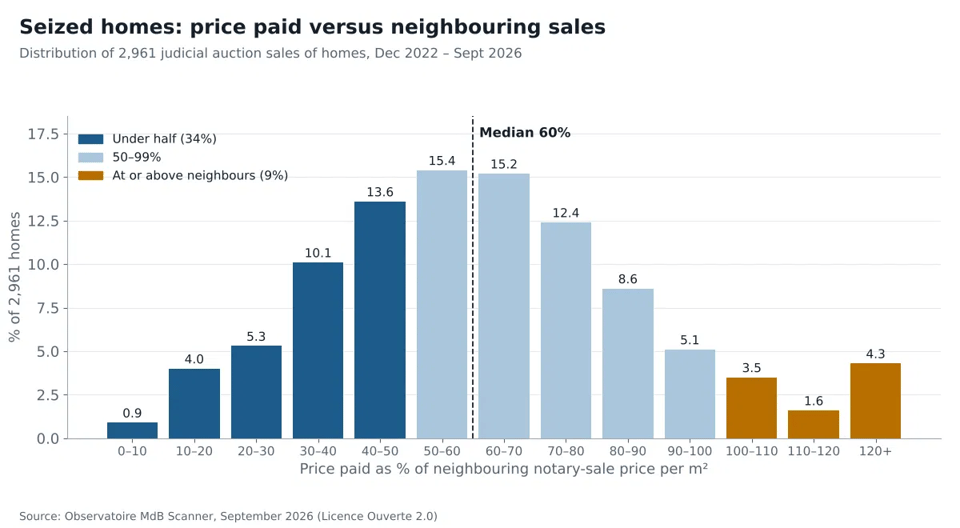
Its answer is that the typical auctioned home sells for roughly 60% of the neighbouring price. Some 34% of homes sold for less than half the neighbouring price and 9% sold at or above it.
The price used is the hammer price, called the adjudication. It excludes transfer duties, lawyers' fees and procedural costs, which a buyer pays on top and which can add considerably to the total cost, often 15% or more.
Although the typical home sold for 60% of the neighbouring price, there were significant variations from this figure. The middle half of homes sold between 44% and 78% of the neighbouring price. A third went for under half. A small group did the opposite: about one home in eleven sold at or above what neighbours fetched, and 4% sold at more than 120%. The averages are for both apartments and houses, whether occupied or vacant.
The figures are shown in graphic form below.
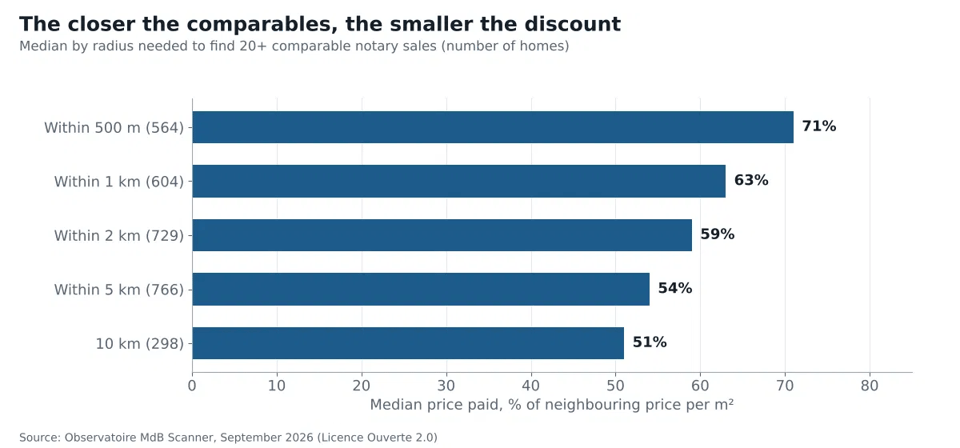
The study also showed that the more closely a home can be compared with its immediate neighbours, the smaller the discount appears, as shown on the graphic below.
Opening Price
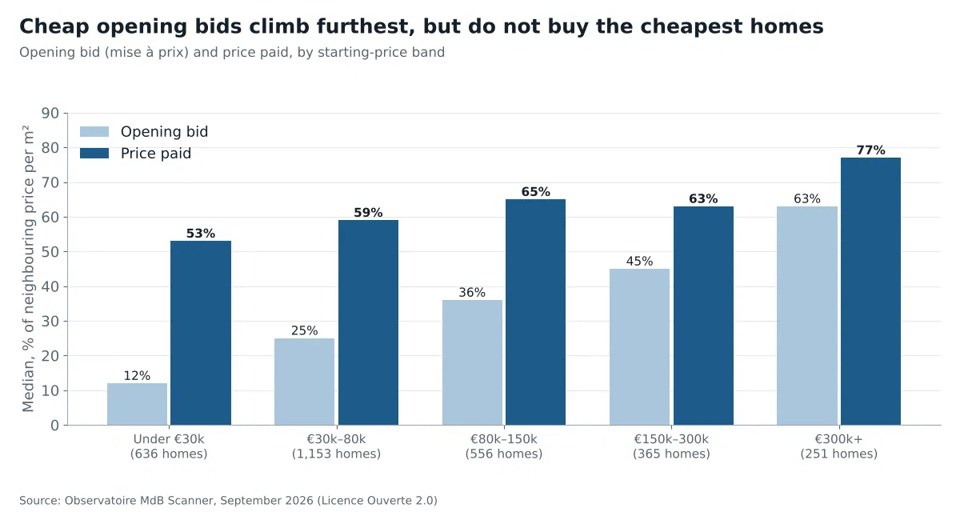
The opening price (mise à prix) in a judicial auction is set by the creditor pursuing the case, often a bank. It is a starting point for the bidding, not an assessment of the property's market value.
The lower the opening price, the further the eventual sale price can move from it. Across all the sales in the study, the final price was on average 1.9 times the opening price. For lots with a mise à prix below €30,000 it was typically 3.3 times. For lots offered at between €150,000 and €300,000 the multiple fell to 1.3, and above €300,000 it was 1.1.
For example, in Toulon an occupied 43m² apartment had a starting price of €15,000 and sold for €48,000. In Canet-en-Roussillon, a vacant apartment with the same €15,000 starting price eventually sold for €122,000. The two properties therefore had exactly the same starting price but completely different outcomes.
Location
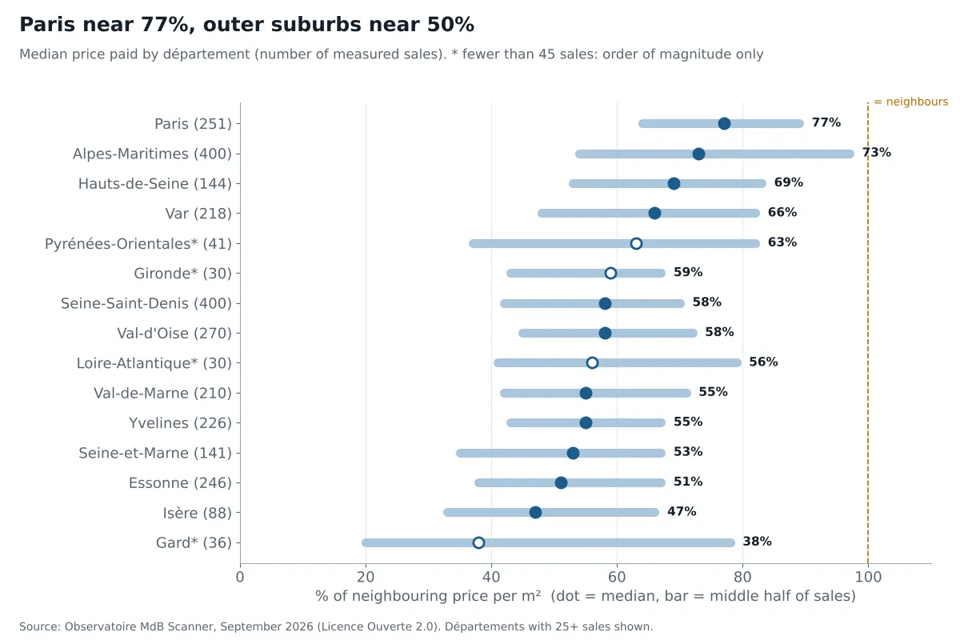
Geography matters more than almost anything else in the data. In Paris the median home sold at 77% of the neighbouring price, and only 9% sold for under half. The Alpes-Maritimes, the department that includes Nice and Antibes, had a lower median of 73% but the widest range of outcomes: 21% of homes sold for under half the neighbouring price, while 23% sold at or above it, the highest share of any department in the study. In outer Paris suburbs such as Essonne (51%) and Seine-et-Marne (53%), nearly half of sales were under half the neighbouring price.
Isère, around Grenoble, shows a median of 47%. The Gard shows 38%, but it had only 36 sales, so it is far from conclusive. Taken together, Île-de-France comes out at 59% against 63% for the rest of the country, an average that conceals the gap between Paris itself and its far suburbs.
These figures are illustrated on the following graphic. Many departments with a low number of sales are not shown.
Occupied homes
Another useful finding concerns the effect of occupation.
Among apartments, an occupied one sold at about 63% of the local comparable price, compared with 71% for a vacant one.
Buying an occupied property can involve dealing with an existing tenant and respecting the tenant's rights. Where the former owner remains in occupation, there may instead be an eviction procedure, with its associated uncertainty, cost and delay. The lower auction price is therefore partly a reflection of the risk being taken on by the buyer.
Interestingly, the study did not find a measurable difference between occupied and vacant houses, although the authors caution that the number of occupied houses in the sample was smaller.
Caveats
The study itself cautions against treating its figures as a list of places where buyers should go looking for bargains. It is measuring what properties actually sold for, not identifying where it is best to buy. The condition of the property was not measured, so a high discount may reflect a property that requires extensive work, has an potentially difficult legal or occupancy situation, or carries other costs that are not reflected in the headline price.
It is also not a complete census. Some 1,767 of the 4,728 sales studied could not be compared, mostly because no surface area was given. Rural properties with few comparable sales are under-represented.
Finally, as stated above, there are additional costs involved in buying a property at a judicial auction, which may amount to 15% or more of the purchase price.