
There are two main forms of assistance, either a tax credit or a grant, although they effectively amount to the same thing.
Tax Credit
A 'tax credit' is an amount deducted from the income tax you owe. If you owe little or no income tax, the remaining credit will be paid to you by the tax authority.
Some tax credits are dependant on your capacity, whilst others are available on an unconditional basis.
i. Unconditional Tax Credits
Certain home improvements are eligible for a tax credit even if no-one in your household is elderly or disabled. In the main, the purpose of such tax credits is to make your home more accessible to visitors and guests.
Thus, the tax authority state: 'Équipements spécialement conçus pour l’accessibilité des logements aux personnes âgées ou handicapées Ils peuvent être installés par les propriétaires..... Aucune condition tenant à la présence effective d’une personne âgée ou handicapée dans le logement ou à l’ancienneté du logement n’est exigée. Seule la qualité de l’équipement spécialement conçu pour ces personnes est prise en compte.'
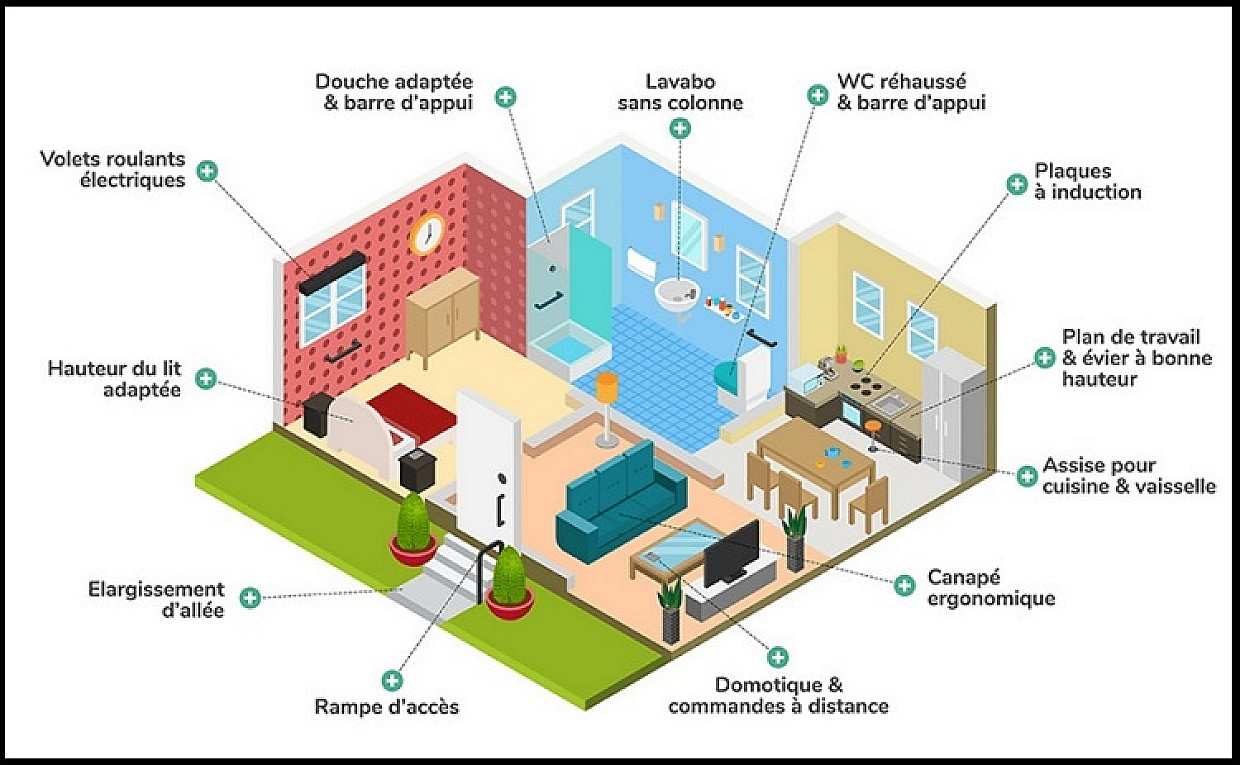
The eligible equipment and facilities include:
-
Height adjustable sinks
-
Raised toilets
-
Handrails
-
Height-adjustable furniture
-
Adapted door handles
-
Stair lifts
-
Fixed ramps
These costs should be declared on your tax return in the category 'Équipements spécialement conçus pour l’accessibilité des logements aux personnes âgées ou handicapées.'
ii. Conditional Tax Credits
To claim tax credits for certain other accessibility-related home improvements, you will need to prove that a member of your household is either:
-
a recipient of a disabled pension at a rate of at least 40%;
-
holder of a French disabled badge (carte mobilité inclusion) or;
-
aged over 60 and eligible for the social benefit Allocation Personnalisée d’Autonomie due to difficulty carrying out certain everyday tasks.
Home improvements that fall into this category include:
-
Walk-in showers
-
Toilets equipped with a washing and drying system
-
Control system equipped with movement detector and alert/warning system
-
Electric blinds
-
Non-slip flooring
-
Sliding doors
-
Adapted doors and windows
-
Guardrails
-
Adaptive switches or control systems for electric, gas, water and heating facilities.
Level of Tax Credit
Tax credits are available for 25% of the cost (including VAT) of the adaptation/installation. Over a five-year period, the maximum credit available is €5,000 for a single person and €10,000 for a couple.
Conditions
The tax authority may ask for proof payment so make sure you keep copies of all receipts and invoices. For this year, invoices must be dated no later than the 31st of December 2023. You may also be asked to prove that that any equipment installed was specifically designed to improve ease of access for disabled or elderly people.
These costs should be declared in the category 'Équipements permettant l’adaptation des logements à la perte d’autonomie ou au handicap'.
Grants
Aside from tax credits, eligible persons are also entitled to a means-tested grant, which is available through a scheme called 'Ma Prime Adapt' There are also more general grants under a scheme called 'Habiter Facile'.
The scheme is run by the government housing agency ANAH (Agence Nationale pour l’Amélioration de l’Habitat).
Examples of work covered by this scheme include stair lifts and walk-in showers.
The table below shows the maximum income level currently required to be eligible, which varies depending on the number of people in your household and whether you live in or outside of the Ile-de-France.
| Income Thresholds 2022 | ||
Household size |
Ile de France |
Regions |
One Person |
€25,714 |
€19,565 |
Two Persons |
€37,739 |
€28,614 |
Three Persons |
€45,326 |
€34,411 |
And then €7,7613/€5,797 for each additional person.
The grant is up to 50% of the cost (excluding VAT) of adaptation work, up to a maximum amount of €10,000, depending on your income.
If you do not fall into either category, it is worth contacting your local public renovation advice agency France Rénov, to see if you still qualify for aid.
Whatever your financial situation, local branches of the ANAH reserve the right to select which projects will receive funding. For example, priority may be given to those with on the lowest incomes.
As a general rule, your property should be at least 15 years old, but exceptional cases will be considered.
The work must be carried out by certified building professionals (you may be asked to choose professionals with a ‘Qualibat’, ‘Handibat’ or ‘Silverbat’ qualification), and you should not have already started the project before applying for the grant. The construction work should cost at least €1,500.
You will be asked to provide documentation proving that yourself or a member of your household is either disabled or is over the age of 60 and eligible for the Allocation Personnalisée d’Autonomie.
You should be planning to live in your accommodation for at least 3 years following the completion of the works.
Application Process
The application process at online at ANAH Habiter Facile. You will be asked to provide your tax return.
Once you have filled in necessary details, you should receive a home visit from an adviser. The adviser will help evaluate your needs and put together a grant application. Following this, your application will be considered by ANAH. If you are successful, you can begin work on your construction project, and should receive payment of the grant within 2 weeks of its completion.
Other Financial Assistance
If you receive a French pension, there may be additional aid available from your retraite complémentaire scheme.
Similarly, there may be specific initiatives available in the department of France where you live. To find out more about succch aid, get in touch with your nearest ADIL (Agence Departamentale pour Infos sur le Logement.)
If you are under the age of sixty and living with a disability which either makes it impossible for you to carry out at least one important daily activity or very difficult for you to carry out at least two important daily activities, you may be eligible for the Prestation de compensation du handicap (PCH). If so, specific funding is available for home adaptations (up to €10,000 over a ten-year period). This is organised at a departmental level, so you need to apply to your local department council.
Tenants
If you live in rented accommodation and a member of your household is disabled and/or elderly, you have the right to make necessary adaptations to the property (at your own cost).
You can also come to an agreement with your landlord to apply for the ANAH grant together on your behalf (you cannot apply directly as a tenant without the agreement of your landlord).
When adaptations have been made for disabled or elderly residents, landlords cannot require you to return the property in the same state as at the start of the tenancy.
Related Reading: