

The natural phenomenon, known as retrait-gonflement des argiles, is an increasing problem in France, with now over half the land area of the country at risk.
Between 1989 and 2022, approximately 446,000 insurance claims were filed for building damage related to this phenomenon.
Insurance premiums have risen substantially to cover the risk, with the mandatory ‘CATNAT’(catastrophes naturelles) surcharge on buildings having increased in 2025 from 12% to 20%.
The revised map replaces the version previously adopted in July 2020.
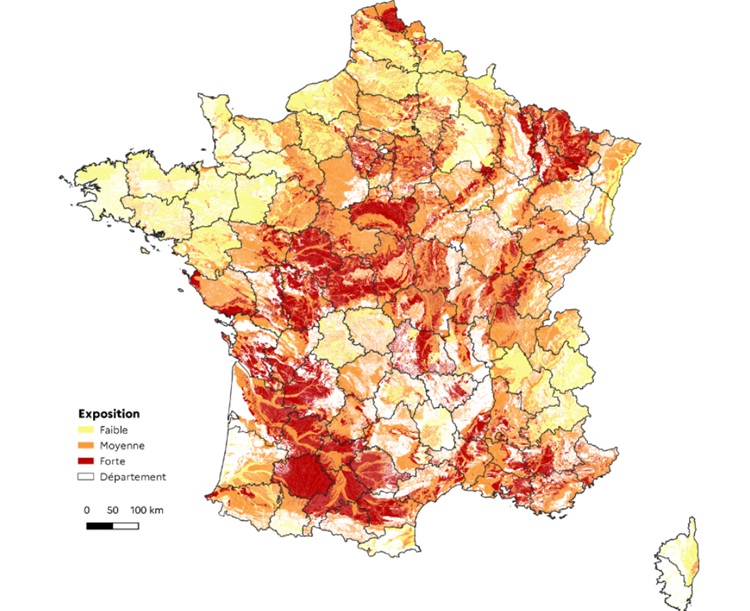
Prolonged droughts linked to climate change have significantly increased the frequency and severity of such damage over recent decades.
The updated map plays an important legal role. It identifies areas classified as having medium or high exposure to clay shrink–swell risk. In these zones, specific building regulations apply.
In practical terms, this means that new construction projects in these areas must include geotechnical soil studies and builders must follow technical standards designed to reduce the risk of structural damage.
The new mapping shows a substantial increase in areas classified as medium or high exposure, with 55% of France’s land area is now classified as medium or high risk (up from 48% in 2020).
Over 12.1 million existing single-family homes are now located in these zones, representing 61.5% of such homes nationwide. In 2020, the figure was 10.3 million homes (52.5%).
The increase is particularly notable in several major administrative regions of France:
Auvergne–Rhône–Alpes - including cities such as Lyon and Clermont-Ferrand: 49% of the region is now classified as medium/high risk, compared to 33% previously.
Bourgogne–Franche–Comté - in eastern France: 74% of the region, up from 58%.
Grand Est - in northeastern France, bordering Germany, Belgium and Luxembourg: 53%, up from 41%.
Centre–Val de Loire - in central France, south of Paris: 90% of the region, compared to 82% previously.
Since October 2025, the updated map has also been used in a new state-backed prevention scheme being tested in 11 pilot departments. These departments are Allier, Alpes-de-Haute-Provence, Dordogne, Gers, Indre, Lot-et-Garonne, Meurthe-et-Moselle, Nord, Puy-de-Dôme, Tarn, Tarn-et-Garonne
Under this programme, owner-occupiers of single-family houses located in high-exposure areas may qualify, subject to income conditions, for public subsidies to fund a technical vulnerability assessment of their property and preventive reinforcement or adaptation works.
Related Reading: