

France has long used financial incentives to encourage the purchase of electric vehicles.
Over the past few years, however, these incentives have undergone significant structural and eligibility changes.
Since 2025 the most significant changes have been the transfer of financial support from the state to energy suppliers, as well as greater means testing.
‘Coup de Pouce’
The main financial assistance is provided through the “prime coup de pouce véhicules particuliers électriques”.
This scheme replaced the former bonus écologique and is financed through the system of energy savings certificates (Certificats d'économie d'énergie - CEE). Under this framework, energy suppliers provide the grants, rather than the central state budget.
The amount of support now also depends mainly on the household’s income:
Low-income (Ménages précaries): up to €5,700
Modest-income households (Ménages modestes): up to €4,700
Other households: around €3,500
In addition, an additional bonus of up to €2,000 has been introduced for electric vehicles that are assembled in Europe with a battery manufactured in Europe.
The maximum eligible income figures depend on household size, as shown on the following table:
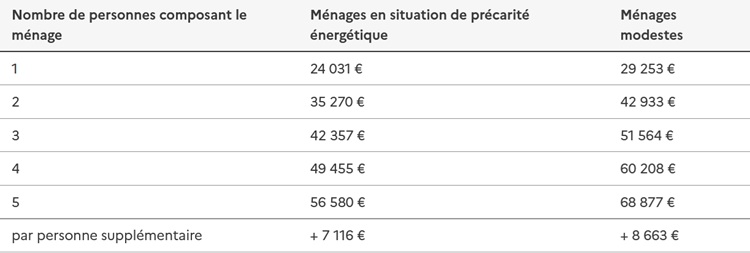
These figures apply in 2026 and may be adjusted annually.
In terms of the eligible vehicles, only new, fully electric vehicles qualify. The full list can be found at Coup de pouce Véhicules Particuliers Electriques.
Leased vehicles are eligible, provided the lease is for a period of at least 2 years. Applicants must also be households (not companies), who are tax resident in France.
How to Apply
In most cases, the aid is deducted directly from the purchase price by the dealership. The dealer then handles the administrative process on behalf of the buyer.
If the aid is not deducted at purchase, the buyer may need to submit an application to an accredited CEE energy partner.
Related Reading: