
Earlier this month the government submitted to the French parliament a draft law on the ‘accélération des énergies renouvelables’.
The measure follows a major speech made by the President in February this year, when he set out his plan to revive nuclear power, develop renewable energy and phase out fossil fuels.
The objective of the plan is to reduce energy consumption by 40% in 30 years and to end reliance on fossil fuels by an increase of 60% in electricity production.
The main elements of the plan are the renovation of housing, the transformation of the car industry and the decarbonisation of industry.
Wind and solar power figure prominently but the plan also seeks to prolong the life of existing nuclear reactors and to also significantly increase the size of the nuclear park. As has been widely reported, at the present time half the 56 nuclear reactors in France are currently out of service due to maintenance.
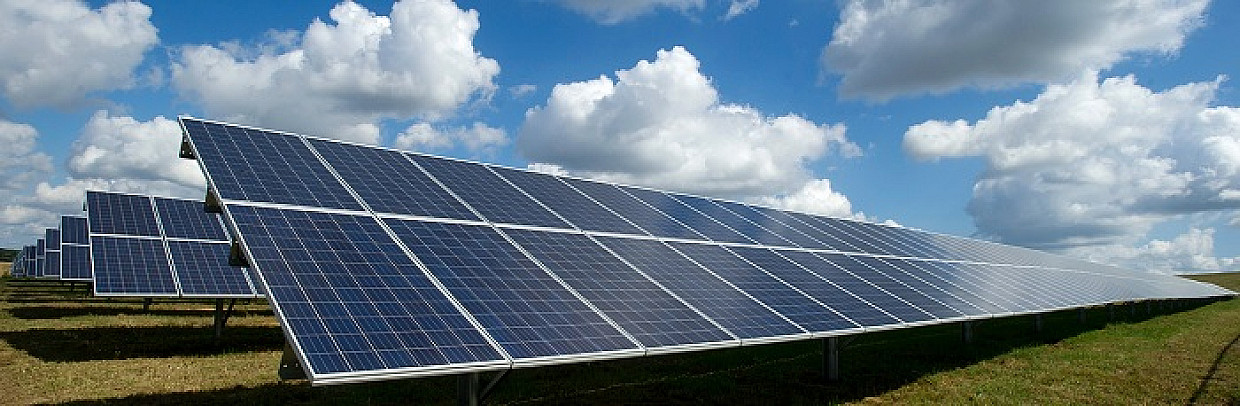
Due to the resistance to on-shore wind power in France, the government have chosen to increase by tenfold the programme for the installation of solar farms, which are considered less controversial. It intends to do that by imposing an obligation of solar panels on large car parks, and by installing them on abandoned roads. The government's own energy agency has already questioned the viability of the scale of programme, as they do not consider sufficient sites are available.
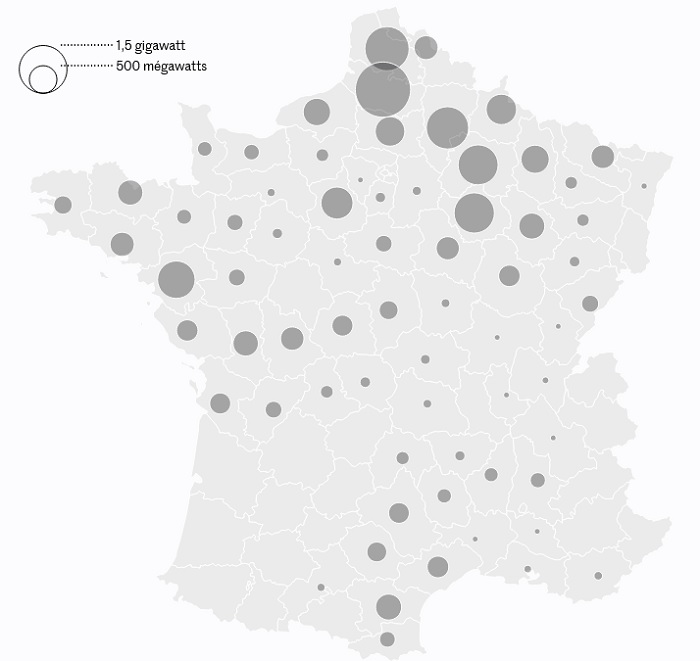
There will also be 50 offshore wind farms to reach 40 GW by 2050, and onshore wind capacity will now be doubled in 10 years, as opposed to 30 years. Over half the current on-shore installations are located in the two regions of Hauts-de-France and Grand Est, primarily due to climatic conditions, as shown on the graphic below.
New Law
The proposed new law aims to put in the place the legal and administrative processes necessary to achieve those objectives, with the accent on simplifying existing authorisation and procurement procedures.
According to the government, it currently takes ten years to develop an offshore wind farm, five years for a solar farm and seven years for a wind farm, around twice as long as most other countries in Europe.
Litigation over on-shore wind farms is particularly strong, with 70% of proposed installations the subject of proceedings in the courts, despite the fact that the courts rarely rule in favour of the protesters.
Although a great deal remains to be specified by decree, there are three main elements contained in the draft law.
One of the key proposals to run in parallel different elements of the authorisation process for projects, rather than sequentially. As might be expected, projects of this nature require not only planning consent, but an environmental assessment and technical validation. Nevertheless, developers have pointed out that nothing is stated about reducing the amount of documentation that must be submitted, which they consider remains very substantial.
Likewise, the government are proposing to increase the threshold that requires submission of an environmental assessment, in order to exempt small projects, but the criteria for doing so are not specified.
Such a proposal also happens to fly in the face of the principle of ‘non-regression' of the environment, which is currently enshrined in a 2016 law on biodiversity. According to that law, protection of the environment ‘can only be the subject of constant improvement.’
Finally, some projects will be given the status of ‘overwhelming public interest’, which will grant them exemption from the environmental conditions it would otherwise need to meet. Once again, there is no detail in the law, which will be left to decree.
In order to make the process of public consultation more democratic, the measure also provides for the introduction of electronic voting as part of any public inquiry into a scheme.
As if to incentivize local communities to vote in favour of such projects, some of the financial benefits of the projects are to be returned to them. According to the government: ‘The idea is that these renewable energies generate a certain amount of income and that these revenues could be redistributed to people who are directly concerned by a visual presence of these means of production," but without specifying what form this would take.
Related Reading: