
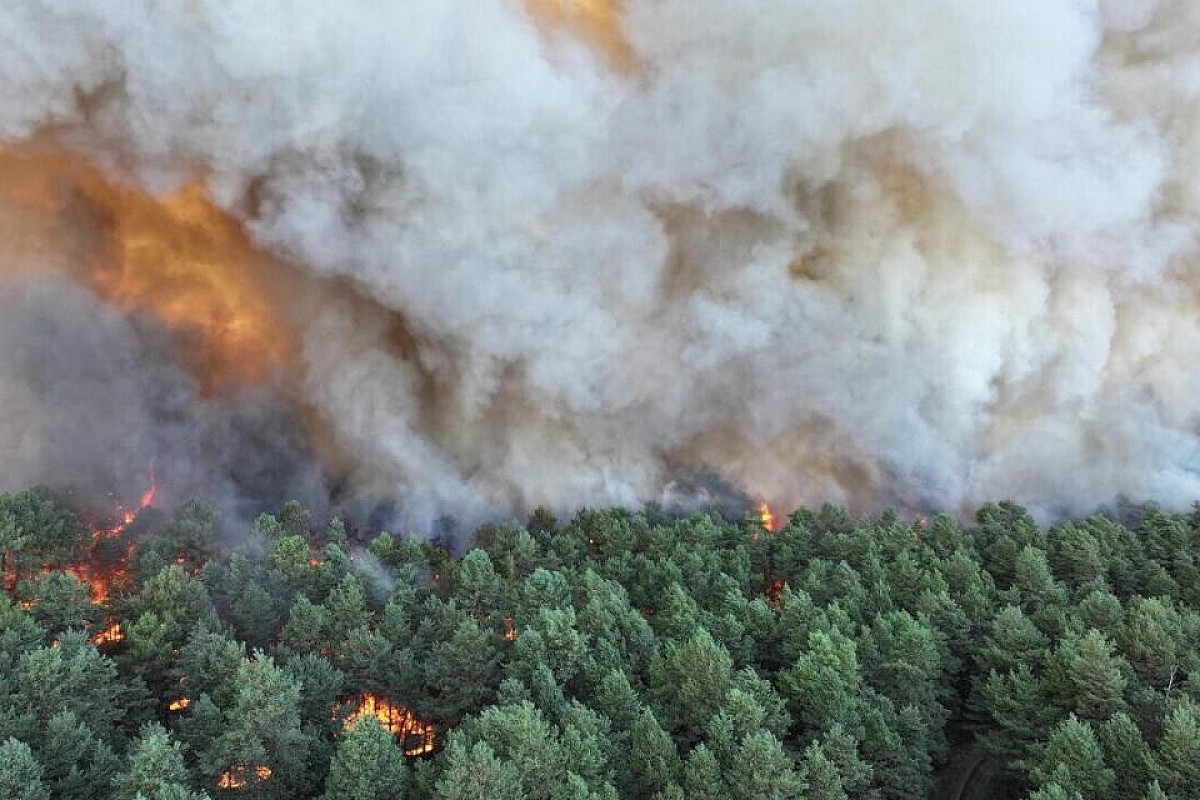
Since Sunday afternoon, around 2000 hectares of the 25,000 hectare historic Fontainebleau forest, south of Paris, have been destroyed in a wildfire.
Around 1000 residents have been evacuated from villages bordering the forest, while 850 firefighters are engaged in what emergency services expect to be an operation lasting several weeks.
The blaze would already rank among the most serious of the summer. But investigators now believe it may not have been an accident.
Visiting the scene on Monday, Interior Minister Laurent Nuñez revealed that investigators had identified around ten separate ignition points within a radius of one kilometre, including fires that began on both sides of the A6 motorway. Such a pattern, he said, "suggests a voluntary origin". Two people suspected of having started the fire have been arrested.
If those suspicions are confirmed, Fontainebleau will be added to the growing list of forest fires that have been started deliberately.
Official data from France's Ministry of Agriculture for 2024 reveals that of the 59% of wildfires where the cause of the fire was determined, only 12% resulted from natural causes such as lightning.
The remaining 88% (9 out of 10) were linked to human activity.
Deliberate fire-setting accounted for 31% of those human-caused fires, making arson the single largest identifiable cause of wildfire in France.
Negligence, including discarded cigarettes, poorly managed agricultural burning, machinery, barbecues and other careless behaviour, accounts for much of the remainder.
The first weeks of July have already seen a succession of fires of suspected or confirmed criminal origin across southern France.
In Hérault, more than thirteen separate fires broke out overnight between 5th and 6th July around the communes of Abeilhan and Carlencas-et-Levas. Gendarmes arrested a 27-year-old man near one of the ignition points, while the Mayor of Abeilhan declared bluntly that the fires were "definitely deliberate".
In neighbouring Gard, near Rémoulins, another suspect was arrested after admitting responsibility for one of two fires that erupted in late June.
Elsewhere, six Mediterranean departments were placed on the highest level of wildfire alert as extreme heat, drought and strong winds combined to create exceptionally dangerous conditions.
In the Pyrénées-Orientales, a major fire forced the evacuation of several campsites and hundreds of holidaymakers.
Since the beginning of the summer, French authorities say 32 people have been taken into police custody for deliberately or negligently starting fires.
Corbières Fire
France is still living with the consequences of last year's catastrophic wildfire in the Corbières.
The August 2025 blaze devastated around 17,000 hectares in the department of Aude, making it the country's largest wildfire since at least 1949. Prosecutors have consistently treated the possibility of a criminal origin as one of the principal lines of investigation.
That inquiry took an unexpected turn in June when three officials from the National Forestry Office (Office National des Forêts - ONF) were taken into custody as part of the investigation. One forestry officer has since been formally placed under judicial investigation on suspicion of involuntary destruction resulting in death. The investigation remains ongoing and no conclusions have yet been reached.
‘Pompiers Pyromane’
One of the most disturbing aspects of fires started deliberately is that many have involved volunteer firefighters -pompiers pyromane as they have become known.
In December 2025, a 25-year-old volunteer firefighter from Tours was sentenced to two years' imprisonment after being convicted of six deliberate fires committed between March and July 2025. Investigators discovered that he had placed himself on duty minutes before each blaze, was frequently among the first to arrive at the scene, and had even alerted the emergency services himself.
Earlier cases have followed a similar pattern.
In October 2024, two volunteer firefighters in the Ardennes were sentenced to three years' imprisonment for multiple deliberate fires committed over more than a year.
In Haute-Saône, two young volunteers received prison sentences after being convicted of setting fire to eighteen agricultural buildings, reportedly motivated by financial gain.
New Fire Era?
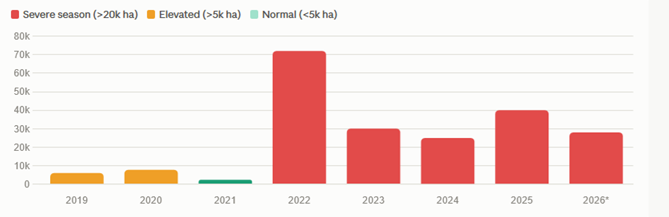
The following graphic shows hectares burned each year since 2019. So far this year, according to the French Ministry of Interior, 28,000 hectares have been destroyed.`Details of active fires can be found at FeuxdeForet.
The 2022 figure is the standout. Fires in the Gironde fires alone accounted for over 72,000 hectares nationally, driven by exceptional drought and an agricultural fire that escaped control at Landiras.
Nevertheless, despite the headlines being captured by forest fires in recent years, historically, France has experienced even worse fire seasons.
During the 1970s and 1980s, annual losses in the Mediterranean region alone frequently exceeded 100,000 hectares, while catastrophic fires in 1982 destroyed approximately 340,000 hectares.
The difference today lies less in the scale than in the geography.
For decades, major forest fires were largely confined to the Mediterranean basin. That pattern is changing.
Recent summers have seen significant fires spreading westwards and northwards into regions once considered relatively safe, including Brittany, the Loire Valley, the Atlantic coast and the forests surrounding Paris.
At the same time, fires are spreading faster than in previous decades.
Longer droughts, repeated heatwaves, lower soil moisture and stronger winds are creating conditions in which even relatively small ignitions can rapidly become major incidents.
France's highly regarded wildfire strategy, introduced in the mid-1990s, relied on the rapid detection and aggressive suppression of every new fire. For almost three decades it proved remarkably successful, dramatically reducing the area burned each year.
Many fire specialists now believe that climate change is beginning to test the limits of that strategy.
Related Reading: