


New figures from the European Union show that last year, to the end of Q3, 100 UK nationals were ordered to leave France.
During the same period, 70 US nationals were ordered to leave, as were 15 Australians and 35 Canadians.
In the case of the UK, 75 of those ordered to leave were males aged between 18 and 34 years, with the remaining 25 also all males over the age of 34 years. No women were ordered to leave, and minors without a parent are entirely protected from expulsion.
In the case of the USA, 10 of those ordered to leave were females. The gender of the Australians ordered to leave is not stated, and in the case of Canada, 10 of the 35 ordered to leave were females.
Not only are the orders mainly against single males, but what the figures do not show are the final outcomes of the order to leave the country. In practice, most of those concerned continue to live in France illegally.
Over the period 2019-2022, 447,257 foreign nationals were issued with an Obligation de Quitter le Territoire Français (OQTF) - an order to leave. There were 134,282 orders issued in 2022 alone. Over 50% of OQTFs issued during the period 2019-2022 were from 10 prefectures, of which 38% were from the Ile-de-France and only 10% from 50 departments.
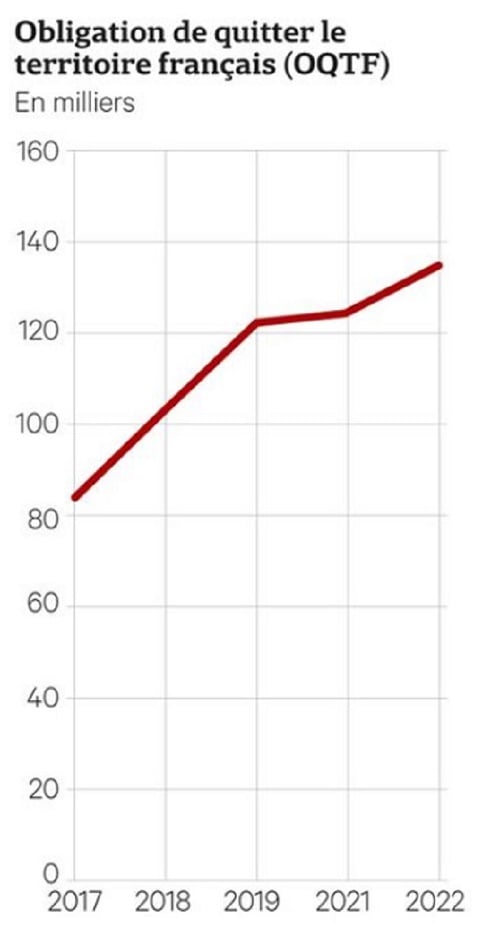
However, a report from the French national auditor, the Cour de Comptes, shows that only around 10% of those issued with such an injunction were eventually removed from the country.
Some of the recipients were able to regularise their situation, whilst others simply continue to live in the country illegally without the order being executed. In 2022, 18% of OQFT cases that went to appeal were annulled by the courts.
The are various reasons why an OQFT may be issued. In many cases it is because a person has been refused a residence permit. Over the period 2019-2022, nearly 110,000 orders to leave the country were issued to foreign nationals who were refused a residence permit. However, only 1,721 (2%) of them were eventually forcibly removed.
In other cases it may be that the individual entered France irregularly in the first instance (mainly asylum cases). 0f the nearly 200,000 of those who did so between 2019-22 only 3,622 (7%) were forcibly removed.
These figures do of course exclude those who voluntarily left the country after being ordered to do so, but here again the numbers are not huge, averaging around 1,500 a year, or less than 1.5% of those issued with an OQTF, according to the national auditor.
They also exclude those who were expelled immediately, through an arrêté d’expulsion, which would apply to those presenting a grave threat to public order or safety.
The report from the auditor gives several reasons for the lack of enforcement, most notably inadequate resources in prefectures and a lack of congruence between the systems of the various agencies involved in the process. The auditor states that the main information system managing foreigners in France is "obsolete".
The authorities estimate that the number of illegal immigrants in France is at least 500,000, although this figure is almost certainly an underestimate, as it is based on those who have received health treatment in France under a scheme of last resort for those irregularly resident in France, called Aide Médicale d’État (AME).
Whilst over the last 10 years the number of orders to leave has increased by 60%, the auditor states that the number of staff numbers has increased by only 9%. The courts are also inundated with immigration cases, accounting for 41% of all cases in the local administrative courts and 61% in the appeal courts. The auditor comments that: "Most prefectures are overloaded, regularly committing legal errors faced with a particularly complex judicial framework, and having difficulty respecting legal deadlines."
Other factors hindering enforcement include problems obtaining legal identification of illegal immigrants, a lack of collaboration with their home country (notably Morocco) and airlines/pilots unwilling to accept them on board an aircraft out of France.
As a result, in recent years the government has given priority to expelling those who have committed a serious crime, or who are a threat to public order. In such cases, the rates of deportation from France are substantially higher. Of 7,225 ordered to leave for committing an offence, 3,273 (45%) were expelled, whilst in the latter case, out of 27,598 ordered to leave 23% were expelled.