

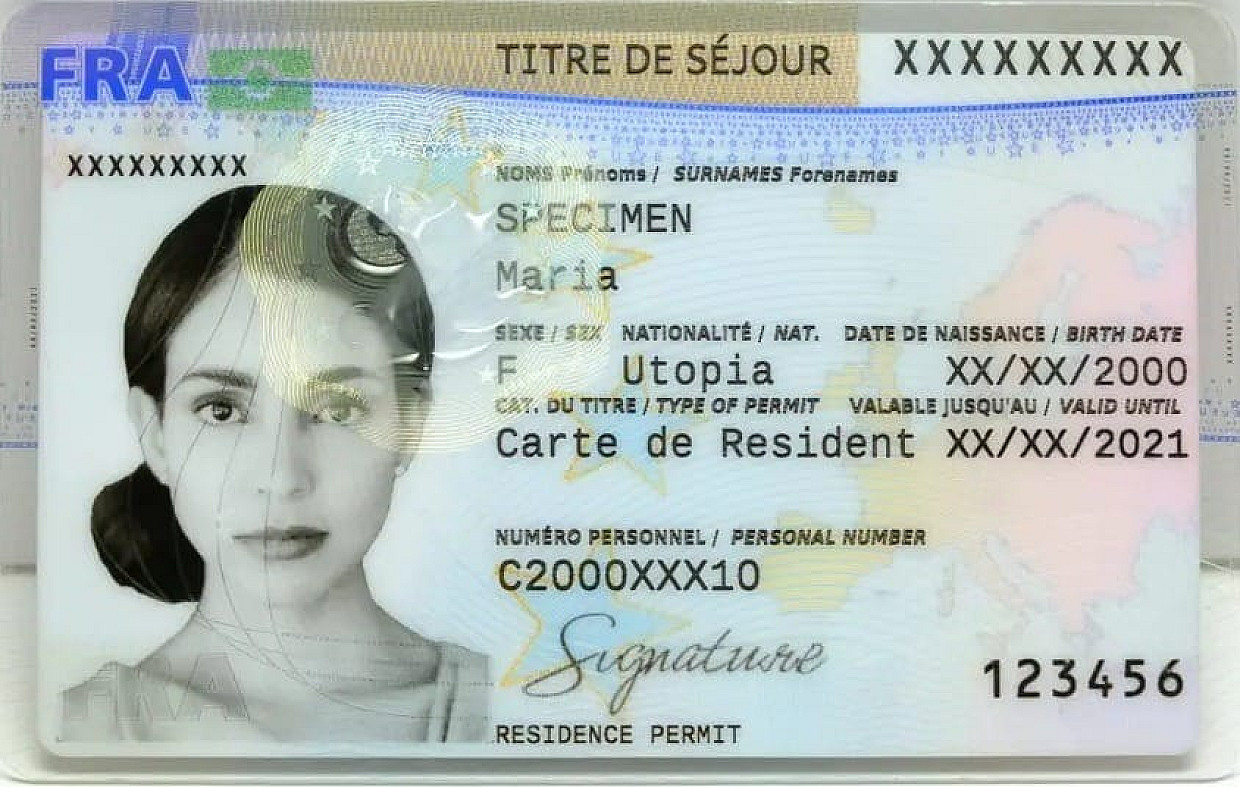
New rules require prefectures to notify applicants of their decision within 90 days of receiving a complete application, replacing the previous four-month period.
The reform affects foreign residents applying for or renewing a carte de séjour, rather than the initial visa applications made before moving to France.
The change comes against a background of mounting delays, growing backlogs and complaints about the difficulties of dealing with the prefectures.
A report published in July 2026 by the Défenseur des droits, France's independent authority responsible for protecting people's rights in dealings with public bodies, highlighted the scale of the problem.
Its investigation found that the average time taken to issue a residence card had increased from 78 days in 2019 to 110 days in 2023, a rise of 41%. For renewals, the Interior Ministry reported an average processing time of 117 days in 2025.
The backlog also grew substantially. The number of applications awaiting a decision at the end of the year rose from 243,000 in 2019 to nearly 403,000 in 2023.
The report identified several reasons. Applications had increased, particularly renewals, but staffing had not kept pace. The number of full-time equivalent staff increased by only 10% between 2019 and 2023, while renewal applications rose by 43%.
The move to online applications has also created difficulties. The ANEF digital platform, through which most residence-card applications are now submitted, has suffered persistent technical problems. Applicants have reported difficulties submitting documents, correcting applications and obtaining information about their progress.
A person waiting for a renewal may find that their existing card expires before the prefecture has reached a decision. Although temporary documents can preserve the right to remain in France, problems obtaining or renewing them can lead to interruptions in employment, housing and other rights.
The Défenseur des droits found that complaints concerning foreigners' rights accounted for 41% of all the cases brought to its attention in 2025, compared with 10% in 2019.
The 90-day Rule
Until now, prefectures generally had up to four months to notify applicants of their decision. Under the new rules, that period is reduced to 90 days from the date a complete application is submitted.
If documents are missing, the 90-day period does not necessarily start when the applicant first submits the file.
Where an application is particularly complex the prefecture may extend the period by a further 30 days, provided it informs the applicant. The maximum period is therefore 120 days in such cases.
The change also affects the consequences of administrative silence. Previously, if the prefecture failed to respond within four months, the application was generally treated as implicitly refused. The new period for an implied refusal is 90 days from submission of a complete application.
The 90-day deadline does not cover every type of residence-card application, eg, EU Blue Card holder and researcher residence cards, both of which have shorter deadlines.
The additional 30 days for complex applications are also prohibited for a number of categories, including the researcher card, certain talent cards, intra-company transfer cards and some family-member applications.
The decree contains no specific transitional provision explaining how the new deadline applies to applications already pending on 30th October. Anyone with an existing application should therefore check how the prefecture is treating their case.
The new deadline is being introduced at a time when prefectures are still struggling to deal with a substantial backlog of applications. This month, Interior Minister Laurent Nuñez told the National Assembly's Law Commission that reducing the backlog remained a priority. He acknowledged that it had not yet been cleared. In April, the Interior Ministry reported that 930,000 residence-permit applications were awaiting processing across France. The scale of the backlog therefore brings into question the validity of the implicit refusal after 90 days without a response.
The UK Work Permit Exemption
The decree also introduces a limited exemption from the usual requirement for a work authorisation when employees of UK-based companies are temporarily posted to France to carry out certain contracted services.
It applies to an employee, of any nationality, who works regularly for an employer established in the UK and is posted to France to provide contracted services. All of these conditions must be met:
a maximum of 12 cumulative months in France;
the work falls within activity areas to be fixed by a joint order of the immigration and labour ministers;
at least one year of the same type of service for that employer immediately before the application to enter France;
at least three years’ professional experience in the sector;
a university degree or equivalent; and
any qualifications legally required for the activity.
Until the order listing the sectors appears, the exemption cannot operate. It covers work authorisation only. It does not remove visa or residence requirements, or the rules on posted workers.
Related Reading: