

Earlier this month the French government published a report on the receipts from the wealth tax (l’impôt sur la fortune immobilière - IFI) for last year, which totalled €1.9 billion, an increase of 6% on 2022.
The IFI, which has been in place since 2018, concerns households whose non-professional real estate assets exceed €1.3 million.
The figure is net of all debts and tax allowances, and concerns not only physical assets but property owned indirectly through company and investment structures, provided they are of a personal nature.
The principal home benefits from an allowance of 30%.
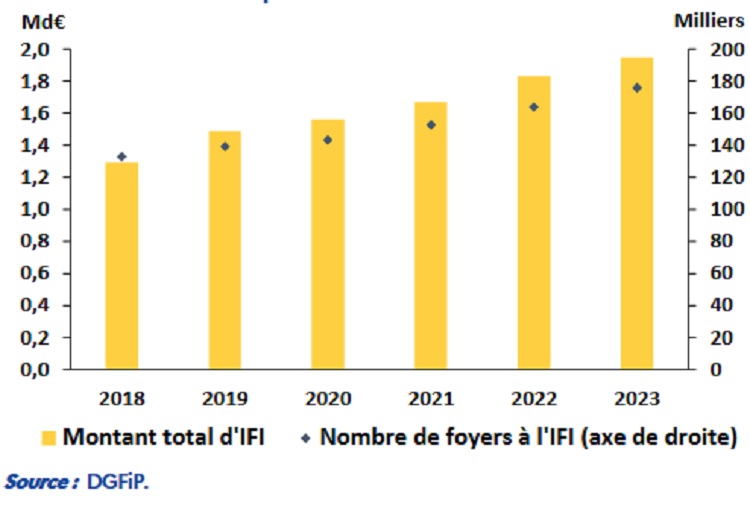
The report states that 176,000 households paid the wealth tax in 2023. Between them they owned real estate with a net value of €434 billion, an increase of 7% over 2022.
The following graphic shows the amount of IFI collected and the number of households for the years 2018 to 2023.
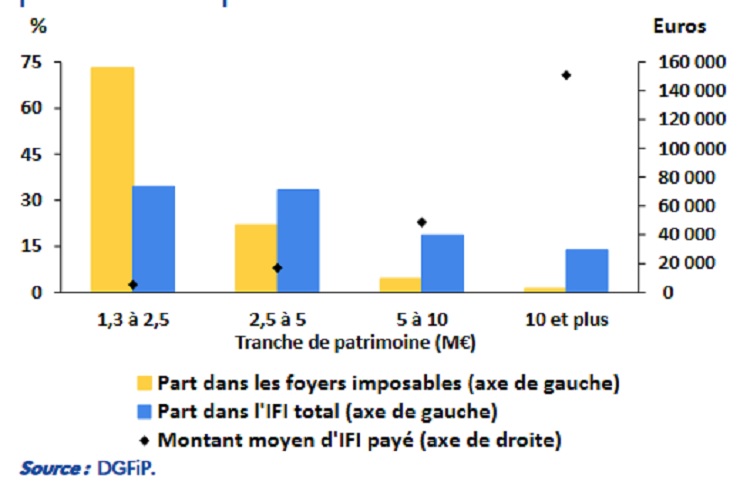
Around three-quarters of those whose made a IFI tax declaration had net real estate assets of between €1.3m and €1.5m, with an average tax liability per household of €5,212, generating 34% of the total IFI receipts.
More than 2 households in 10 declared assets between €2.5 million and €5 million, paying on average €16,900 per household, equivalent to 5% of total receipts.
The remaining households (around 5%) above €5 million in property assets, accounted for 34% of total receipts.
The average amount of tax paid across all households who declared IFI was €11,100, a slight decrease on 2022.
The graphic below shows the breakdown by household group and amount paid.
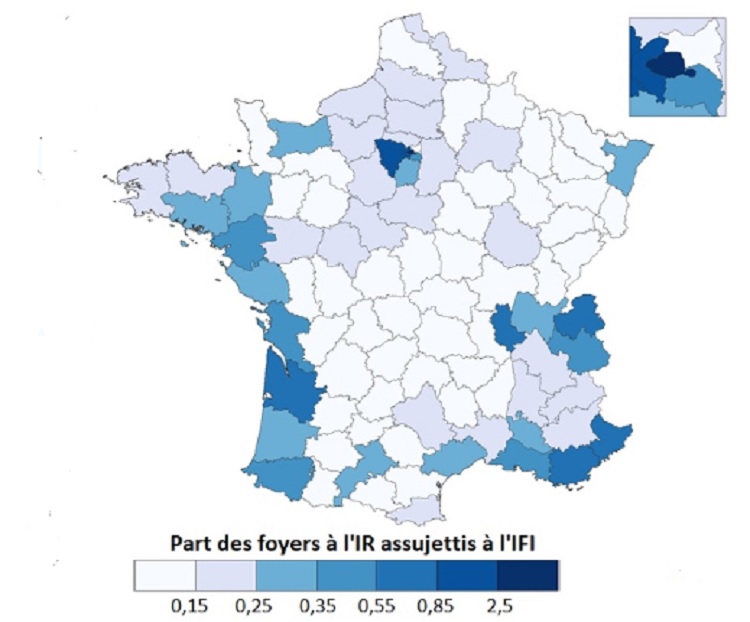
Out of the 176,000 households who paid the tax, 43,000 (nearly 25%) lived in Paris. The capital city was followed by Hauts-de-Seine, 16,000 households (9%) and Yvelines, 8,200 households (5%), both departments in the Ile-de-France.
The remaining taxpayers were located primarily along the Atlantic coast and the Côte d’Azur, as shown on the graphic below.
The average age of the taxpayers was 70 years, with 70% over 65 years of age.