

If you are a 'third country' national (non-French and non-EU) travelling to France or the EU in the coming future, and you have a passport which is part of the Schengen Unified Visa Waiver program, you will have to obtain an European Travel Information and Authorisation System (ETIAS) travel authorisation before you arrive.
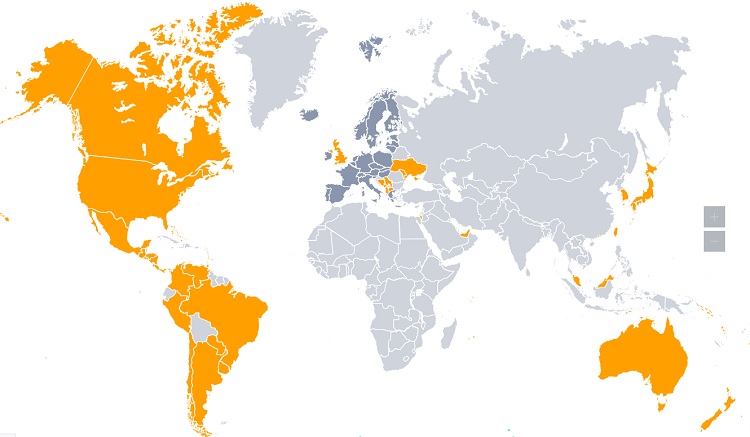
Those affected by the change are nationals from 60+ countries who are able to travel to Europe for up to 3 months without the need for a visa, as shown coloured orange on the graphic below. The system does not apply to the 22 Schengen countries (dark grey) or those countries where a visa is required (light grey).
What is ETIAS and why was it created?
Many EU member countries realised that the lack of internal border controls within the EU make it more difficult to detect illegal activity and to track individuals who may pose a threat to internal border security. Illegal immigration and human trafficking are also growing concerns.
In November 2016, the Commission proposed to establish the ETIAS, a system designed to strengthen security checks on those persons who travel visa-free on short-term visits to the EU.
ETIAS is an automated IT system, which will help identify security risks, irregular migration, or high epidemic risks posed by TCN (third country nationals) who can enter Schengen under the visa waiver program, while allowing the vast majority easy access who do not pose any risk.
It integrates with various law enforcement databases and national visa databases to facilitate the verification of visitors to Schengen and the EU.
There continue to be delays in the introduction of the system originally planned for the end of 2022 but the latest date is now April 2026.
This pre-screening program is not unique and is similar to many electronic travel authorisation programs worldwide.
What does this mean for Travellers?
Each traveller who wishes to enter the Schengen area under a visa waiver must apply for and receive an ETIAS authorization. If the planned stay is longer than the 3 months of the visa waiver then the traveller must apply for a national long stay visa and ETIAS is not required.
While it's an added complication to those who enjoy the simplicity of visa-free travel to France and the Schengen area, it only costs €20 and will be easy to apply for online and by an app on a mobile device. There is no charge for those over 70 and under 18 years of age.
The ETIAS for France has a validity of 3 years or until the corresponding passport expires, during this time holders can enter Schengen for a maximum of 90 days.
One consequence of an electronic exit and entry system is that it will make it easier for the authorities to check on those who may be abusing the 90/180 day visa free rule, although passport stamping will remain in place.
How to apply for an ETIAS Authorisation
Applications will be made through an online portal and a smart phone app which will be released in the next few months. If a traveler needs assistance a third party can fill out the application for them.
The cost will be €20, payable by credit card or other approved payment method.
The system will conduct checks against EU information systems and border control systems.
An approval will be emailed to the provided email address within minutes in most cases. In a small number of cases it can take up to 30 days to issue the authorization.
The most difficult applications will be transferred to ETIAS National Units for manual processing, where the applicant will receive a response by email, containing either the travel authorization or a justification for the refusal.
Any refused applicants have the right to an appeal. This must be done with the member state which made the denial, following the national law of that state. Notice of the member state responsible will be given to the applicant we well as information regarding the procedure that needs to be followed.
Prior to boarding, all air, sea, and land carriers are obligated to verify the valid travel status of each person travelling, along with their ETIAS travel authorisation if required.
Those holding a valid residence permit for a country within the EU, have freedom of movement status under EU law, and those who are a national of an EU or Schengen country are exempt from providing this proof. Accordingly, UK nationals living in France with a residence permit are exempt.
In Practice
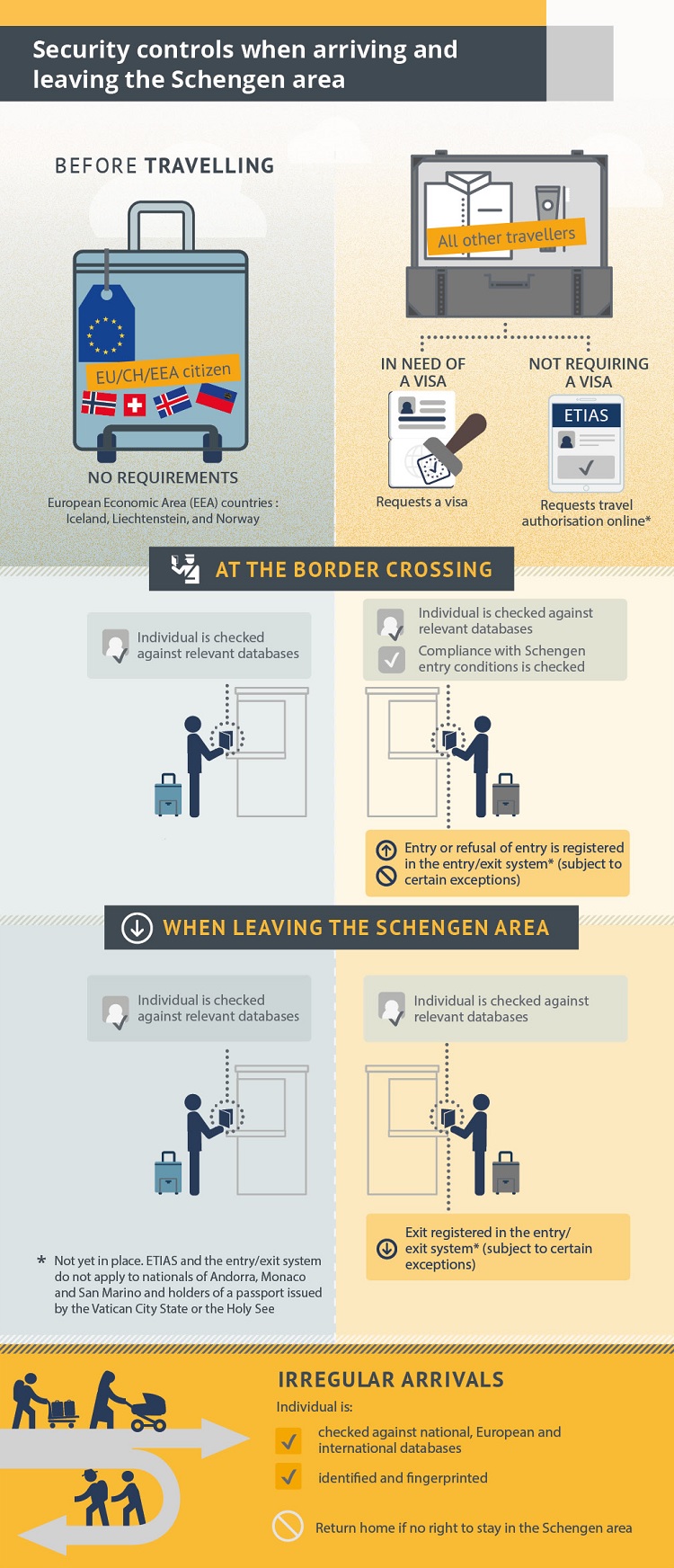
Before Travelling:
No requirements for EU/CH/EEA citizens.
All other travellers: Those in need of a visa should request one. Those not requiring a visa should request travel authorization online.
At the Border Crossing:
EU/CH/EEA citizens: Individual is checked against relevant databases.
All other travellers: Individual is checked against relevant databases. Compliance with Schengen entry conditions is checked. Entry or refusal of entry is registered in the entry/exit system (subject to certain exceptions). ETIAS and the entry/exit system do not apply to nationals of Andorra, Monaco and San Marino and holders of a passport issued by the Vatican City State.
Leaving the Schengen Area:
EU/CH/EEA citizens: Individual is checked against relevant databases.
All Other Travellers: Individual is checked against relevant databases. Exit registered in the entry/exit system (subject to certain exceptions). ETIAS and the entry/exit system do not apply to nationals of Andorra, Monaco and San Marino and holders of a passport issued by the Vatican City State.
Irregular Arrivals:
Individual is checked against national, European and international databases. Identified and fingerprinted. Return home if no right to stay in the Schengen area.
Data Retention
The system fully complies with the EU Charter of Fundamental Rights. Individuals have the right of redress and the right to judicial remedy in the case of an error. Personal data will be stored for the period of validity or 5 years after the last refusal, revocation, or annulment of the travel authorization.
*Schengen Area
The 22 Schengen countries in the EU are: Austria, Belgium, Czech Republic, Denmark, Estonia, Finland, France, Germany, Greece, Hungary, Italy, Latvia, Lithuania, Luxembourg, Malta, Monaco, Netherlands, Poland, Portugal, San Marino, Slovakia, Slovenia, Spain, Sweden, Vatican City.
The non-EU States in the Schengen Area are: Iceland, Norway, Switzerland, and Liechtenstein. There are 4 countries that are in the process of joining Schengen and will require ETIAS: Croatia, Cyprus, Bulgaria and Romania.
Related Reading:


