


According to a recent report by the Centre national de la musique (CNM), two-thirds of the festivals supported by the institution ended their 2024 editions in deficit, with the average loss soaring by 73% year-on-year to an average of €115,675 per festival.
The 2024 findings are stark: 68% of festivals with attendance rates above 90% are operating at a loss, a 26-point increase compared to 2023.
This deficit is rising sharply (+212%) due to the increase in the number of loss-making festivals in the highest budget categories. Unlike in 2023, the majority of festivals with budgets exceeding €3 million were in deficit in 2024.
Despite a 2% increase in average capacity (29,400 attendees), average attendance has stagnated (22,200 tickets issued), leading to a slight drop in the average fill rate (77%, down from 80% in 2023).
Organisers find themselves caught between relentlessly rising costs and sluggish revenue growth.
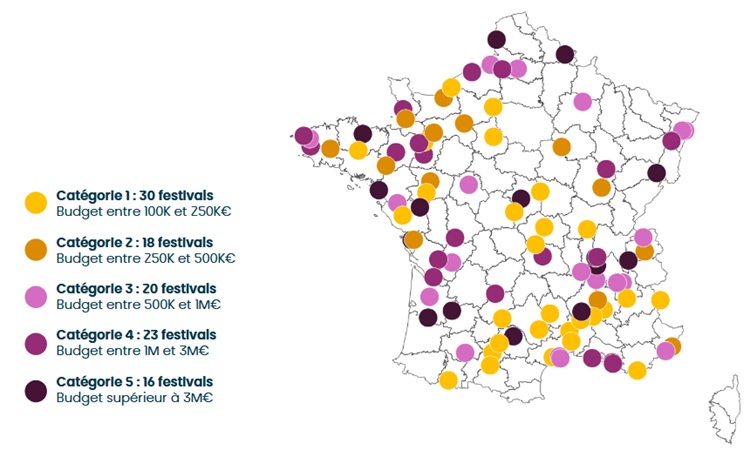
The CNM analysed data from over a hundred supported festivals in 2024 (46% of the festivals supported by CNM), as shown on the graphic below. Several festivals in the Ile-de-France are not shown.
The study highlighted a persistent “scissors effect”: expenses rose by an average of +6%, while revenues increased by just +4%. Among the cost drivers, technical (+6%) and artistic (+9%) expenses are particularly burdensome.
Insurance costs, which surged by 49% between 2019 and 2022, continue to climb (+14% in 2024).
Partnerships and sponsorship, both up in the year, have become lifelines for many organisers.
However, these gains are insufficient to bridge the gap. Public subsidies, though slightly increased, remain essential, particularly for smaller festivals: they represent 44% of the budget for events with budgets between €100,000 and €250,000, compared to just 13% for those with budgets exceeding €3 million.
“Festivals face an impossible equation: soaring costs and revenues that can’t keep up,” summarizes a CNM official. The increase in CNM support (+13%) and local government funding (+5%) only partially mitigates the crisis, failing to address the root problem. “Without structural rebalancing, many festivals risk disappearing,” warns the official.
The CNM study also reveals another trend: festivals’ growing reliance on private partnerships. Larger events, in particular, are increasingly turning to patronage and sponsorship to balance their books.
Conversely, smaller festivals, often run by non-profit-making associations, remain heavily dependent on public subsidies. “This divergence is widening inequalities within the sector,” notes one observer.
In response to the crisis, several avenues are being explored: overhauling funding models, pooling costs among festivals, and more equitable distribution of public support. Some are calling for a national dialogue to rethink the role of festivals within France’s cultural ecosystem. “We need to act quickly, or a significant part of our cultural heritage could be lost,” stresses one industry professional.
The CNM, for its part, advocates stronger support and collective reflection on the economic sustainability of festivals. “These events are vital drivers of employment, tourism, and social cohesion. Their disappearance would have far-reaching consequences beyond the cultural sector,” the institution stated.
Related Reading: