
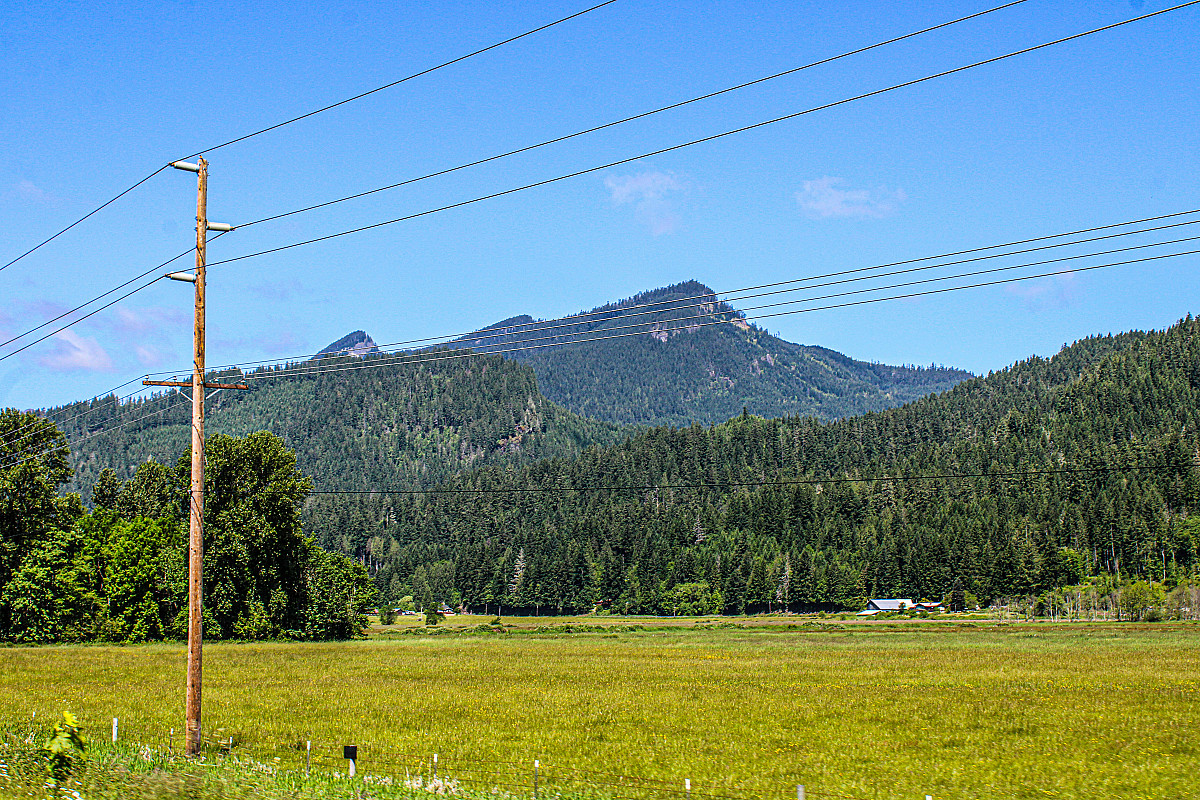
Every year, with overgrown or fallen trees landing on telephone and electricity lines, causing faults or cuts to services, a substantial repair and maintenance obligation arises.
As might be expected, there are laws that set out the lines of responsibility between the public service providers and property owners, but different rules apply, depending on whether they are electricity or telephone lines, and in practice neither set of rules is clear-cut.
An attempt to increase clarity and impose a stronger obligation on the public service providers was recently made in the French parliament, but the government rejected the move stating that: "The legislation in force ......appears proportionate."
So just what are the rules?
Electricity Lines
Under L 323-4 of the Code de l’énergie, ENEDIS, the public utility arm of the electricity distributor EDF (and RTE for high voltage cables) has the unequivocal right to cut trees and branches that interfere with lines, stating they may:
'couper les arbres et les branches qui, se trouvant à proximité de l’emplacement des conducteurs aériens d’électricité, gênent leur pose ou pourraient, par leur mouvement ou leur chute, occasionner des courts-circuits ou des avaries aux ouvrages.'
The law also sets down minimum distances that must be maintained between trees and electricity lines, which vary between 1 and 5 metres, depending on whether the lines are high or low voltage. For low voltage lines in the countryside, the minimum distance is set at 1 metre.
Where the trees are located adjacent to the public highway ENEDIS have a legal obligation to undertaken regular maintenance to maintain these distances.
However, private property owners have a similar responsibility where:
The tree is planted on private property and overflows onto the public domain where the power line is located;
The tree was planted after the installation of the power line on the property;
The tree is near the connecting service cable to the property.
In practice, however, the boundary between the public domain and private property is not always easily defined, especially adjacent to highways, and it may not be clear if the tree was planted before or after installation of the line. Likewise, damage to a line from a fallen tree following a storm cannot easily be attributed to neglect by an owner.
Moreover, even where the line is on private property, owners are not permitted to come within 3 metres of a line and such work is only permitted with the consent of ENEDIS by an accredited contractor. If you are proposing work, your contractor will advise you whether consent is required, and the process for obtaining it.
In general, therefore, in the vast majority of cases, it is ENEDIS who assume the responsibility, and do so at their own charge.
Although, property owners may feel some comfort from that, as the maintenance cycle can be 5 or more years, ENEDIS contractors can often be rather severe in their approach to pruning, which may result in the complete loss of a hedgerow or severe pruning of a tree.
If, therefore, you receive notice of a planned visit by EDEDIS contractors to undertake maintenance, you would be well advised not to leave them entirely to their own devices!
Telephone Lines
In relation to telephone lines, the rules are far less satisfactory, as the telephone provider Orange has no direct obligation to the clearance of vegetation, whether on the public highway or private land.
On the contrary, it is property owners who are responsible for the maintenance of trees and hedgerows alongside telephone lines.
This means that in the public domain it is generally the local council who have the responsibility; where the pylon and cable are located on private land it is the property owner.
Nevertheless, as with electricity lines, the division between the public and private estate cannot always be easily identified and where a fault occurs on your line due to overhanging trees adjacent to the public highway it may well require that you get a contractor to deal with it. If in doubt, you need to discuss with the local council who is responsible. If you want early action taken, you may well simply have to assume responsibility.
Where the cause of a line problem is due to overhanging branches belonging to another recalcitrant property owner, the problem is not one that can easily be resolved. Although the telecoms provider does have an obligation to provide a permanent service to their customers, their intervention on the land has to be one negotiated with the owner, failing which the operator is required to obtain a court order for access.
The law does, however, provide several cases where the public telephone operator is responsible:
Where costs are particularly high;
Where the operations present technical or practical difficulties of a nature to undermine the security and integrity of the networks;
When the owner cannot be identified;
When the owner is in default.
In relation to the first two instances, an agreement must be reached with the owner.
If the private property owner is negligent in performance of their maintenance obligations, the telephone operator can demand the intervention of the local council who can, in the last resort, carry out the work themselves and recharge the owner, a power they also hold in relation to overhanging trees on the highway. Failing this, the council can recharge the operator.
Related Reading:
© 2022 France-Insider All Rights Reserved