

In recent weeks the French press have made much of the prospective increase in local rates bills that have started to be received by householders.
With the abolition for all households (excepting second homeowners) of the taxe d'habitation since 1st Jan 2023 the only remaining domestic rates bill is the taxe foncière.
A report published by the government this week states over 80% of councils have decided to leave their rates charge unchanged for this year. The councils who impose it are the local communes and the inter-communal councils.
That does not, however, mean that rates bills for those households will remain the same as last year, as the government have increased by 7.1% the rateable value of properties, on which the rates are calculated.
The annual revision of rateable values (revalorisation forfaitaire) is normally modest, but as it is inflation linked the rise has been a substantial one this year.
The table below shows the percentage increase in rateable values in selected years since 1981.
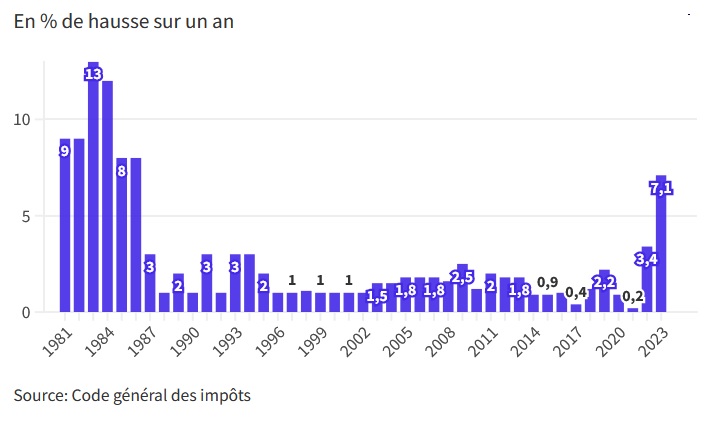
As a consequence, although inflation is falling in France, experts consider rateable values are likely to increase by around 4% in 2024.
The government report states that where local councils have decided to increase their own charge, over half have done so by less than 1%.
A small number of councils - 1.3% of local communes and 0.4% of inter-communal councils - have even decided to reduce their rates.
It is not, however, good news for all households, as the report shows that 24 councils have decided to increase their rates by 25%+, but a list is not given.
Some of the highest rises being reported are in Paris (+52%), Grenoble (25%) and Metz (14.3%).
In contrast, in over 90% of the inter-communal councils the increase was no higher than 4%.
The national average level of the taxe foncière for residential properties is around €1,000, Nevertheless, the charge varies considerably across the country, and by type and size of property.
Separately, the government have published the enlarged list of those councils who will be entitled next year to impose a surtax on the taxe d'habitation of second-home owners. Contrary to the impression being given by several press reports, which suggest that many favoured rural destinations of international property owners are being hit by the tax, the spine of the changes is in coastal and mountain areas. Neither are all councils going to adopt it.