

We reported last year on a change in the law concerning the taxe d’habitation on second homes (Taxe d’habitation sur les résidences secondaires - THRS )
Although the tax has been abolished for main residences, it is still in place for second homes, with more home-owners also liable to pay a supplement, which may vary from 5% up to 60% of the basic tax.
As a result of the change in the law the number of municipal councils entitled to impose the surtax has risen from 1,136 to 3,697.
However, these councils only have a discretionary power to impose the surtax. Many chose not to do so, as part of their tourism strategy. Others impose the tax due to the pressure on the housing market.
As the government explained last year, the main objective of the surtax is to "put vacant housing or second homes back on the permanent housing market and thus limit the rise in prices and rents in these municipalities."
New figures recently published by the government show that where in the past 25% of the councils imposed the surtax, for 2024 that percentage has risen to 40%.
So, whilst in 2023 around 300 councils imposed the tax, now nearly 1,500 will do so. The number will vary from year to year, as the tax is decided on an annual basis by the councils.
As can be seen from the graphic below, most of the councils concerned by the surtax are located on the coast, and in the main it is the municipalities on the Atlantic coast that apply the surcharge, more often and more strongly.
Unsurprisingly, three regions popular with tourists have the largest number of municipalities that have instituted it in 2024: Auvergne-Rhône-Alpes, Provence-Alpes-Côte d'Azur and Occitanie have 316, 293 and 171 councils respectively. This is more than half (53%) of the total eligible.
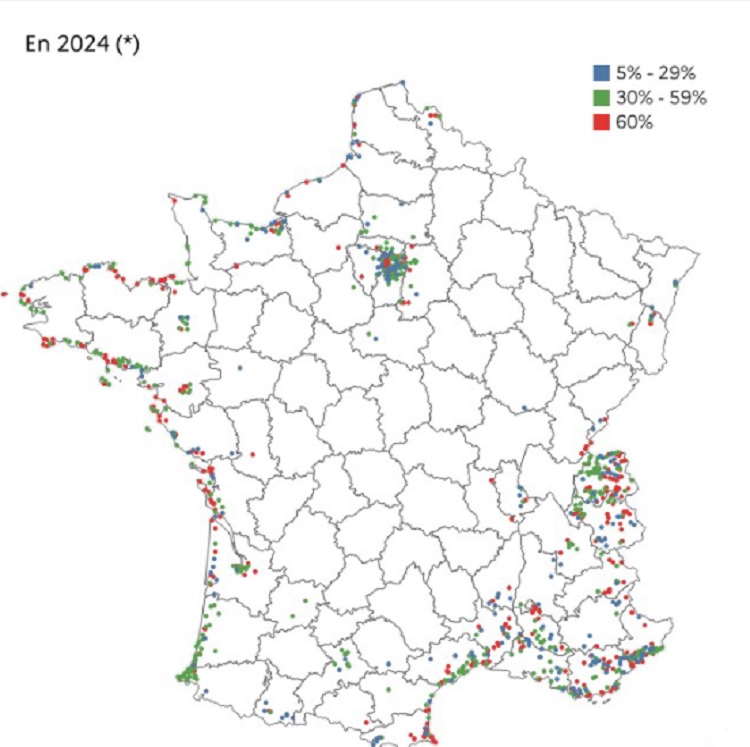
However, it is Brittany that dominates the ranking with nearly eight out of ten eligible municipalities that have implemented it. The latter is followed by Pays-de-la-Loire (61.4%) and Nouvelle-Aquitaine (58.5%).
In terms of the percentage rate applied, proportionally no more municipalities have chosen to set the maximum rate. Thus, of the 1,461 councils concerned, 37% of them (i.e. 539 councils) voted for the maximum rate of increase of 60%, compared to 39% in 2023 (120 municipalities).
A complete list of the councils who have applied the tax, and the rate they have adopted, can be found at the annex to the government report at
Délibérations de taxe d’habitation des communes.