


The prefectures are the local administrative arm of the State, responsible, alongside the local councils, for the delivery and control of public services, such as land use planning, schools, identity cards, passports, residence and work permits, consumer standards, economic development and management of the police and the fire and rescue services. There is a prefecture in each department.
According to the auditor, their report is an update on "ten years of an uninterrupted reduction in staff" since major reforms were commenced in 2010.
The central purpose of these reforms has been to drive the public away from visiting their local prefecture towards on-line services, such as those for a driving licence, vehicle registration, passports, residence permits and other administrative acts.
The digitalisation of these processes is providing the government with the opportunity to rationalise the network of local public offices and reduce the number of public officials.
This is frequently causing delays in the processing of some administrative acts, as many foreign nationals making an application for a residence permit or seeking French nationality can testify.
Since 2010, no less than 11,000 posts have been abolished, equivalent to 14% of the workforce.
The job cuts in the prefectures, says the Cour de Comptes, "have not been realistic" leading to situations where the only way to be able to continue to perform essential tasks has been to recruit short-term contract workers, "who make their incumbents more precarious and disrupt the services."
The auditor is harsh both on the results and on the method, stating: "The job cuts would have justified a reflection on the distribution of the effort according to the reality of the needs of each region. The opposite has happened since the distribution of cuts has only been aimed at preserving historical balances unrelated to the evolution of the population or activity."
The workforce in the prefectures decreased between 2010 and 2020 from 27,613 to 23,652 (-14%), job cuts mainly affecting administrative staff whose numbers have been reduced by more than a third (-34%). Over the same period the number of staff dealing with security has increased marginally (+1%).
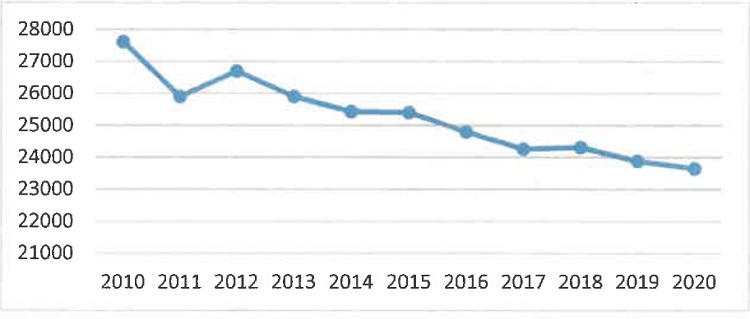
The main victims of these staff reductions have been the sub-prefectures, making these structures (at least those that have not simply closed) "very fragile", notes the auditor.
Another negative consequence of this situation, says the auditor, is the "massive use of individual contractors", recruited in extremis to cope with "peaks in activity", particularly in the issuing of permits.
The application process for residence permits has previously been the subject of critical reports by the French Ombudsman and the French Parliament, mainly due to the waiting times that occur and the poor quality of the on-line systems.
More recently, the supreme administrative court in France, the Conseil d'etat, has added its own weighty opinion to the reliance on on-line systems for residence permits and other services, which they say are not up to the job. They have ruled that applicants must be able to use a paper-based alternative and to be able to have physical access to local officials.
The widespread chaos that occurred with the introduction of the on-line vehicle registration system has also been a huge embarrassment to the government, since compounded by substantial delays that are occurring in processing the exchange of foreign driving licences.
In 2018 the ombudsman produced a report that was also critical of the pace of transfer to on-line services, stating, "a too rapid digitalisation of public services leads to risks of exclusion and an increase in an inability to use rights, jeopardising the equality of all before the public service, which constitutes a fundamental principle of the Republic".
For the auditor, this situation cannot continue: "We cannot be satisfied with the fact that public employment becomes a vector of precariousness", he states.
In response to the report the Minister of the Interior, Gérald Darmanin, who is responsible for the prefectures, indicated by letter to the auditors that he "shares their findings" and that he has chosen to "stop the decrease in jobs in the prefectures."
However, he stopped short of promising any increase in staff to repair the damage that has already been inflicted on services.
Related Reading: