
The decision is the latest chapter in a long-running saga about the use of insecticides, pesticides and weedkillers in France and across the EU.
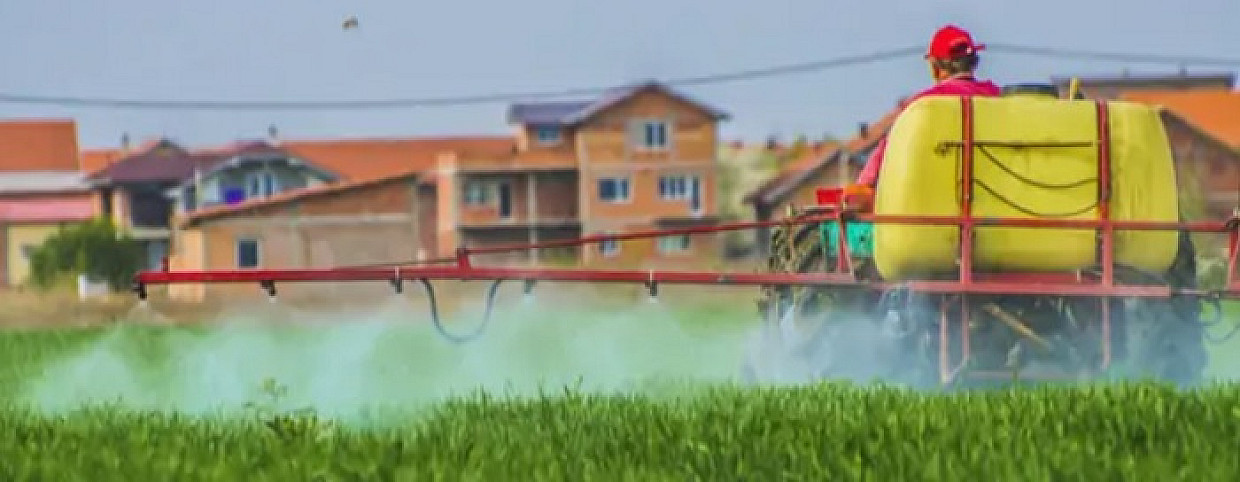
This is now the third time in 5 years that Conseil d’Etat has ordered the government to act to protect the population against the dangers of pesticides, notably by requiring the creation adequate minimum distances.
The legal action was brought by a group of France's leading environmental and consumer protection associations. Farming bodies have brought counter actions, considering the regime excessive.
Legal Position
Since 2018, a general law has been in place subordinating the use of pesticides near homes to suitable measures of protection, including minimum distances, all of which was to be specified in regulations that would be prepared.
Whilst the minimum distances for Category 1 pesticides known to be carcinogenic have been established at 20 metres, only 1% of the chemicals sprayed by farmers are in this category.
For the remaining 300 products that are only "suspected" by public health authorities of being carcinogenic, mutagenic or toxic no minimum distances have ever been clearly specified.
In the absence of stronger central government regulation, there have been numerous instances of mayors introducing local regulations on the use of pesticides, but these were challenged by the government and farming bodies and ruled to be illegal.
Court Rulings
Following a ruling in 2019 by the Conseil d'Etat condemning the government for a lack of action, new minimum spreading distances near residential areas of 5 metres were established for vegetable crops and cereals.
However, campaign groups challenged the regulations on the basis that the distances were not enough and did not protect water points and watercourses during spraying.
In January 2022, with another court ruling going against them, the government asked the public health agency, the Agence Nationale de Sécurité Sanitaire de l'Alimentation, de l'Environnement et du Travail (ANSES), to examine the matter. They painstakingly started setting individual minimum distances for each product, but reducing them if, for example, the farmer had equipment to restrict the direction of the spray. This led to cases of minimum distances being set of only 3 metres, which the associations say swerves the intention of the court's ruling.
Campaigners therefore brought a further legal action, resulting in a ruling last month, with the Conseil d’Etat considering that minimum distances had not been established for all products, and that a fixed 10 metre minimum distance by default was not satisfactory.
The court also considered that more information should be provided to pesticide users and inhabitants living in proximity to where pesticide spraying was taking place.
In its decision, the court highlighted the "seriousness of the consequences of the partial failure of execution in terms of public health" and "the particular urgency that results from it".
If the government doesn't act within two months, it will face fines of €500 a day. The government have yet to respond to the ruling.
The associations are continuing with their campaign, as they consider that 10 metres isn't far enough; research shows that up to half the amount of chemicals sprayed remain in the air up to 300 metres away.
Glyphosate
Although the Cateogory 1 pesticide glyphosate was not in play during these court hearings, President Macron has yet to fulfill his election promise to ban it entirely by 2021.
It was removed from the shelves of gardening stores in January 2019. Domestic use is said to have accounted for around 60% of the volume used annually in France.
French farmers are, however, a force to be reckoned with and they have fought tooth and nail to retain glyphosate, saying that without it they cannot compete with farmers outside France.
As a result, the government has flip-flopped on the target dates to end its use.
The matter is now with the European Commission who have granted a further lease of life to the pesticide, pending a report by the European Food and Safety Authority (EFSA) in July 2023.
Related Reading: