

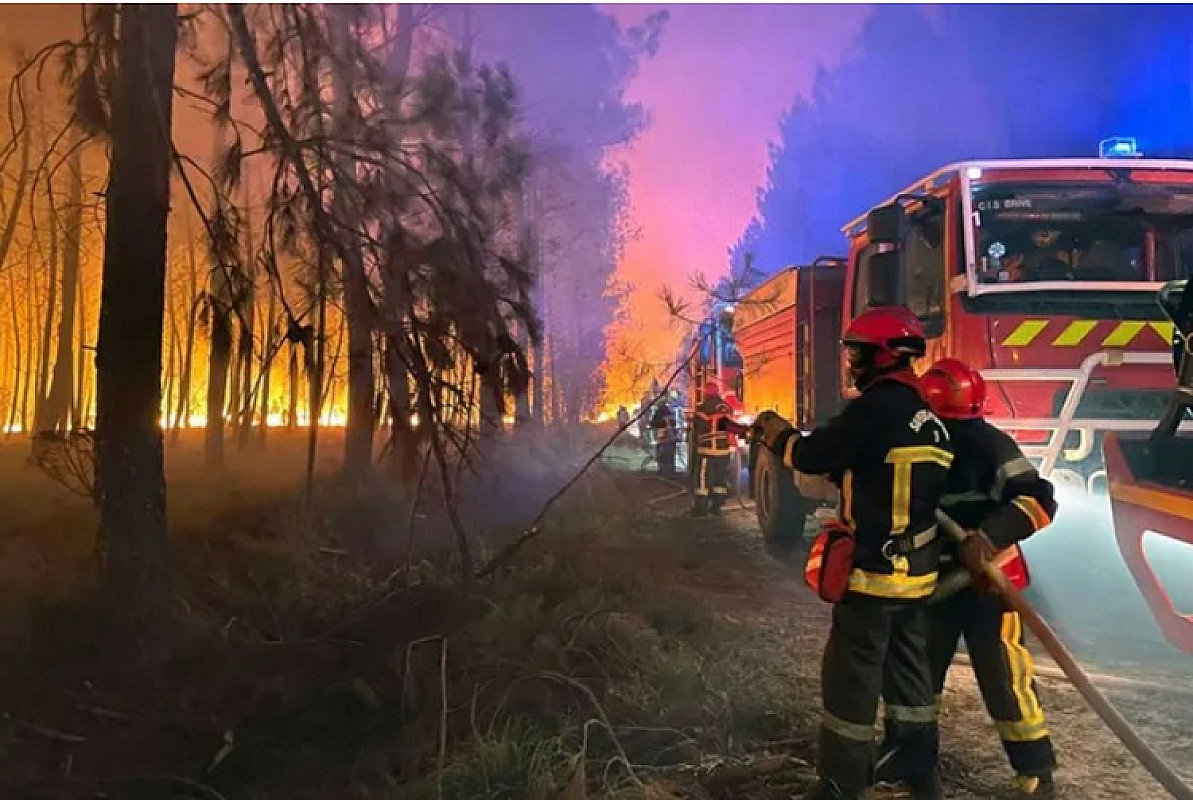
Between June and September this year over 70,000 hectares of land were ravaged by blazing fires, 6 times higher than the average of the past 10 years.
Most serious fires occurred in the south-west, but there were also major incidents in the Mediterranean, Jura and Brittany. In total, half the departments in France were hit.
Heavily dependent on volunteer sapeurs-pompiers, the fire services were unable to cope with the scale of the emergency; aid had to be drafted in from Germany, Romania, Austria and Poland. In addition, 4 Canadairs, the specialist fire dousing planes, were deployed from Italy and Greece.
The extent and frequency of the wildfires has increased enormously in the last decade, but the number of personnel to deal with them has not kept pace.
In 2022 there were a total of 251,900, of whom 78% (197,100) are volunteers, only 17% (41,800) are professionals, and 5% (13,000) military – numbers virtually unchanged for more than a decade.
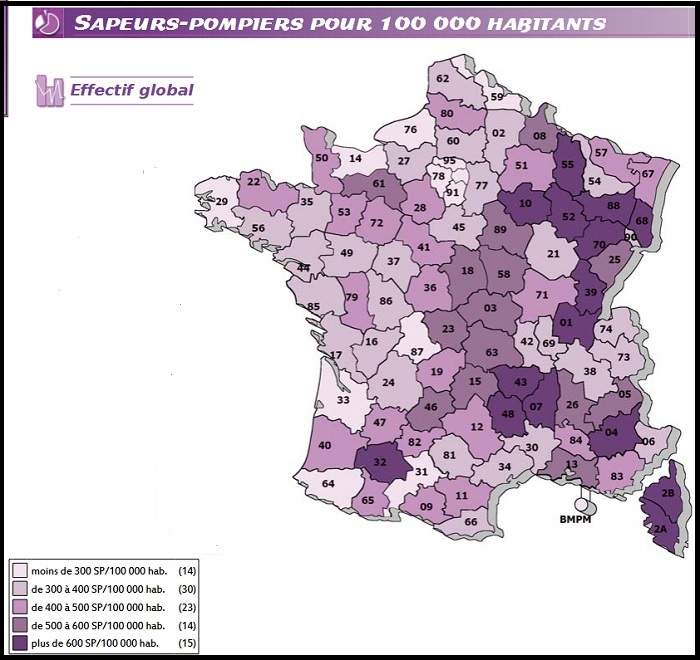
The reliance on volunteers also means that the distribution of total numbers across the country is very uneven, running from less than 300/100,000 population in 14 departments to over 600/100,000 in 15 departments, as can be seen on the graphic below.
As a result, there have been demands to equip the force better, to meet the challenges of the future.
In a statement last month President Macron stated that: "We need to think of a new strategy, better prevent fires, strengthen the means of fighting, and reforest and sustainably manage our forests," before announcing additional resources to fight forest fires.
Chief amongst the proposals was to increase the number of Candadairs from 12 to 16 by 2027 and to replace the existing aircraft in service. In addition, there would be two new helicopters and an additional 10 helicopters made available on loan from the army.
He also promised that departments (Service Departmentale d’Incendie et de Secours - SDIS) would receive an additional €150million to assist, in particular, with resilience work in at-risk areas. That is a significant increase on an existing budget of around €600million a year, although critics have pointed out that when divided between the 101 departments it is only around €1.5m/department.
There was also a promise to improve the financial compensation payable to companies to release volunteer firefighters for longer periods, whose remuneration would also be increased.
Nevertheless, no details were provided on just how much of an increase they would receive, and the speech was light on the question of increasing firefighter numbers.
Earlier this year the Fédération nationale des sapeurs-pompiers de France (FNSPF), in a joint statement with other partners, warned that: “After a constant struggle the firefighters and all the civil security forces are on the verge of rupture. All the lights are red.”
The secretary general of the Syndicat de Pompiers called for the recruitment of another 15-20,000 professionals to compensate for the increase in emergencies over the last 10 years. The FNSPF estimates that the number of volunteers must reach 250,000 by 2027 in order to have an effective force to protect forests and communities.
The falling numbers and lack of recruits is unsurprising when one looks at the conditions under which the volunteers serve.
They are not paid when inactive and, when they are in operation, the remuneration is a meagre €8.36 per hour, up to €12.58 for officers (allowances are increased for Sundays, public holidays and nights). The income is, however, free of income tax, although not social security contributions.
They must serve regular shifts at the fire stations for physical training, maintaining equipment and admin tasks whilst ‘on-call’. If not at the rescue centre, they must remain within a very limited radius.
There is a requirement to carry out regular 12 or 24-hour shifts during weekends or public holidays and outside normal working hours 7pm to 7am. On average volunteers are mobilised 6 times per month.
Compounding the ‘bodies on the ground’ shortage, in October 2021 140 professional pompiers and 5,000 volunteers were suspended for refusing Covid vaccinations!
There are calls to make it easier and more appealing for young people to join the service. In 2019 there was a national action plan to attract more women into the service; currently 19%. It has also been suggested that the career of pompier would be more appealing if it was re-designed so that they have the skills and flexibility to change jobs and not be ‘stuck for life’.
Other proposals contained in the speech by the President were to have stronger enforcement of the obligation of 'débroussaillement' (grounds clearance) by households, to plant 1 billion new trees over the next 10 years, and to introduce a new fire monitoring and alert system so that the rescue services could respond more quickly.
Related Reading: