
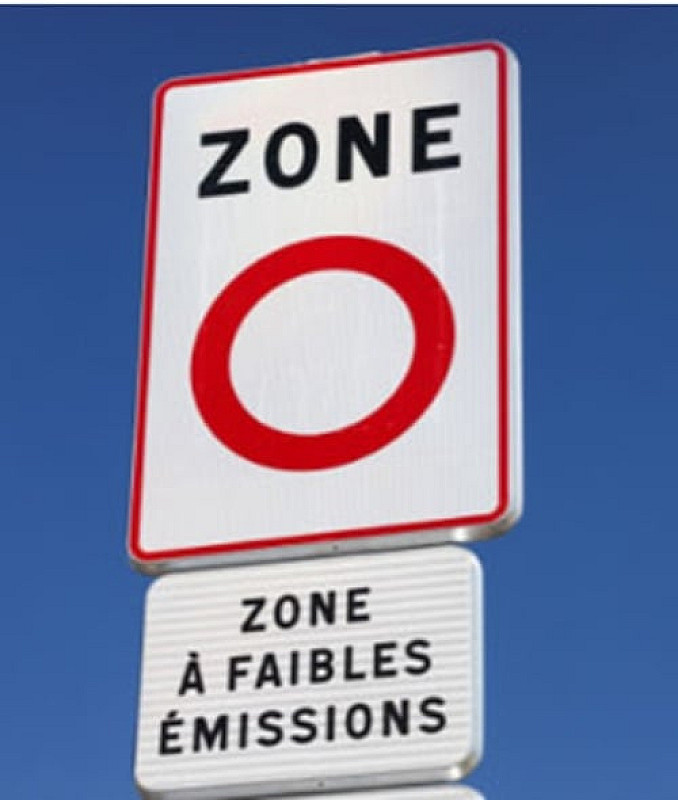
The ruling has thrown the country's clean-air policy into confusion, reinstating 25 low-emission zones (ZFE — zones à faibles émissions) that Parliament had voted to abolish just five weeks ago.
The zones, first introduced in 2019, then expanded in 2021, restrict access to urban areas for the most polluting vehicles in an attempt to improve air quality in France's largest agglomerations.
In theory, they affect an estimated 2.7 million vehicles across the 25 towns and cities that have formally adopted the restrictions.
The Council did not rule on the merits of the low-emission zones themselves. Instead, it found that the clause abolishing them was a cavalier législatif, which is parliamentary jargon for a provision inserted during debate that has no genuine connection to the legislation it was embedded in.
In plain terms, the judges concluded that a measure dismantling an environmental programme had no business being tucked into a bill concerning economic simplification.
What is a ZFE?
Under France's 2021 climate law, towns and cities with populations above 150,000 are required to designate low-emission mobility zones and progressively restrict access by vehicles with poor emissions ratings. Not all have yet done so. Vehicles are classified under the Crit'Air sticker system, from Crit'Air 0 (cleanest) to Crit'Air 5 and unrated (most polluting). Each council sets its own rules on which vehicles are excluded and when, leading to a patchwork of different regimes across the country.
Five towns — Amiens, Douai-Lens, Dunkerque, Le Mans and Saint-Nazaire — are currently exempt because their air quality has improved sufficiently to meet legal thresholds.
With the notable exception of Grenoble (and, soon, Lyon) no French city has fined a driver for entering a ZFE in an ineligible vehicle. Local authorities repeatedly extended so-called "educational phases" reluctant to penalise drivers whose only offence was owning an older car they could not afford to replace.
Paris occupies a distinctive position, as the capital’s restrictions pre-date the national ZFE framework. However, no fines are being issued, as there is a grace period to the end of this year.
In an immediate practical sense, the ruling returns France to its pre-April legal position. The obligation on towns and cities of more than 150,000 inhabitants to maintain ZFEs is restored.
In reality, however, the landscape has barely changed. Little or no enforcement was happening before the abolition vote, and the proximity of the presidential election next year is also likely to make stricter enforcement politically sensitive.
Pierre Chasseray, director-general of the motorists' lobby Association 40 Millions d'Automobilistes, stated that, "We are a year away from the presidential election," he said. "Nobody is going to risk fining drivers when this scheme was scrapped by a large parliamentary majority. Even reinstated, the ZFEs are completely enfeebled. They are dead and buried."
On verra.
Related Reading: