
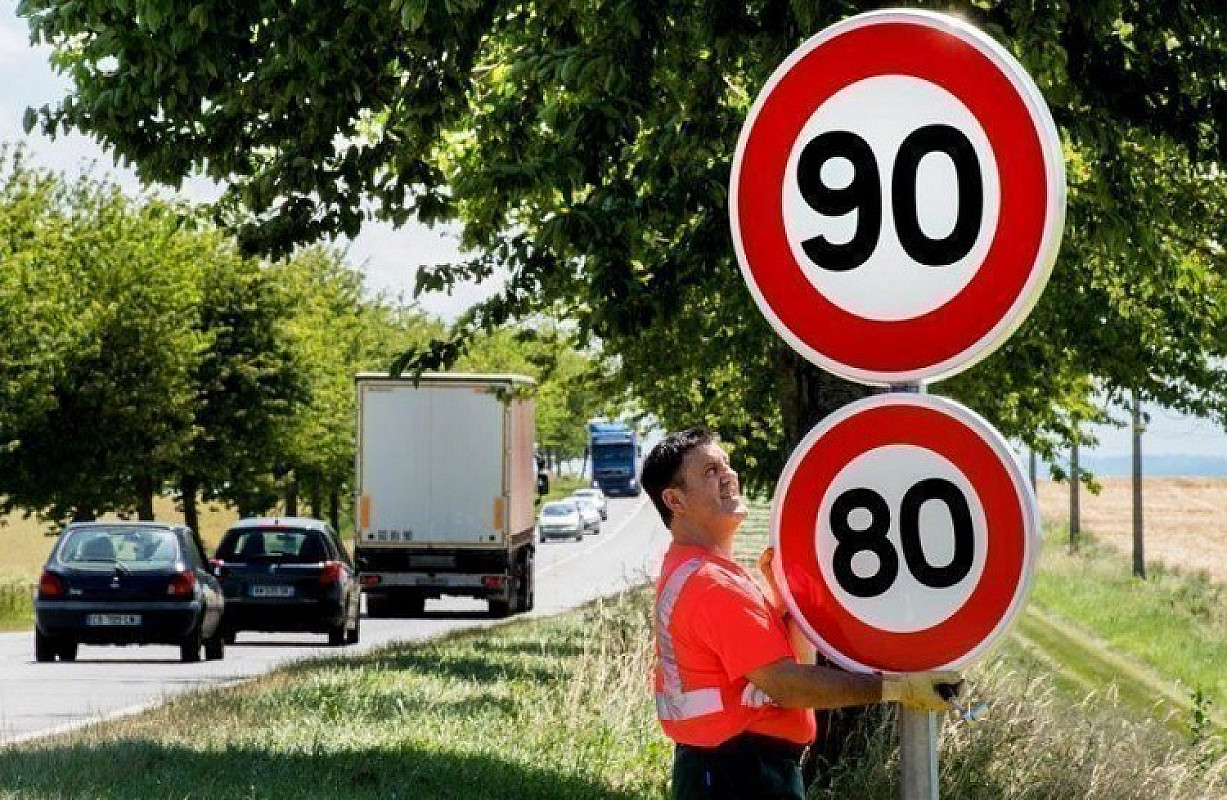
Since July 2018 an 80kph speed limit has been in place on secondary departmental roads in France that have no central barrier, and where road signs indicate no other speed limit applies.
The decision sparked a huge amount of controversy, to the extent that in 2019 the law was changed to allow departments to return to 90kph, subject to the advice of the local road safety committee, who were all issued with 'guidance' by the government.
That advice stated that there should be no return to 90kph on stretches of road less than 10km long, that had public transport stops along them, that have a substantial number of heavy goods lorries using them, or which are used by agricultural vehicles.
In addition, the roads eligible for the 90kph limit are those that belong exclusively to one department, and which do not pass through any hamlets, or have any junctions.
Although the advice of the road safety committees is not mandatory, ignoring it can have consequences, as the Herault departmental council found out, when their plan to return to 90kph was annulled by the local tribunal, who considered that the council had not provided clear enough arguments for lifting the speed limit.
Nevertheless, around half of the departments have chosen to increase the speed limit on some or all roads. The issue is also consideration in several departments that have yet to make a decision.
As can be seen from the graphic below, in most cases there has only been limited application of the discretionary power, no doubt due to the constraints that apply. In total, around 14% of the 52,000kms of departmental roads now have the higher 90kph speed limit.
Seven departments have decided to increase the limit to 90kph on all departmental roads. Those departments are Puy-de-Dôme, Aveyron, Allier, Corrèze, Creuse, Cantal and Ardèche, all rural, some of the least densely populated departments in France.
The table also shows in red those departments where all the departmental roads continue to have a maximum speed limit of 80kph.
To date, eight departments have not yet officially voted for or against the return to 90 kph and, therefore, do not appear in the table. They are Essone, Drôme, Gironde, Essonne, Landes, Pas-de-Calais, Pyrénées-Atlantiques, Vendée.
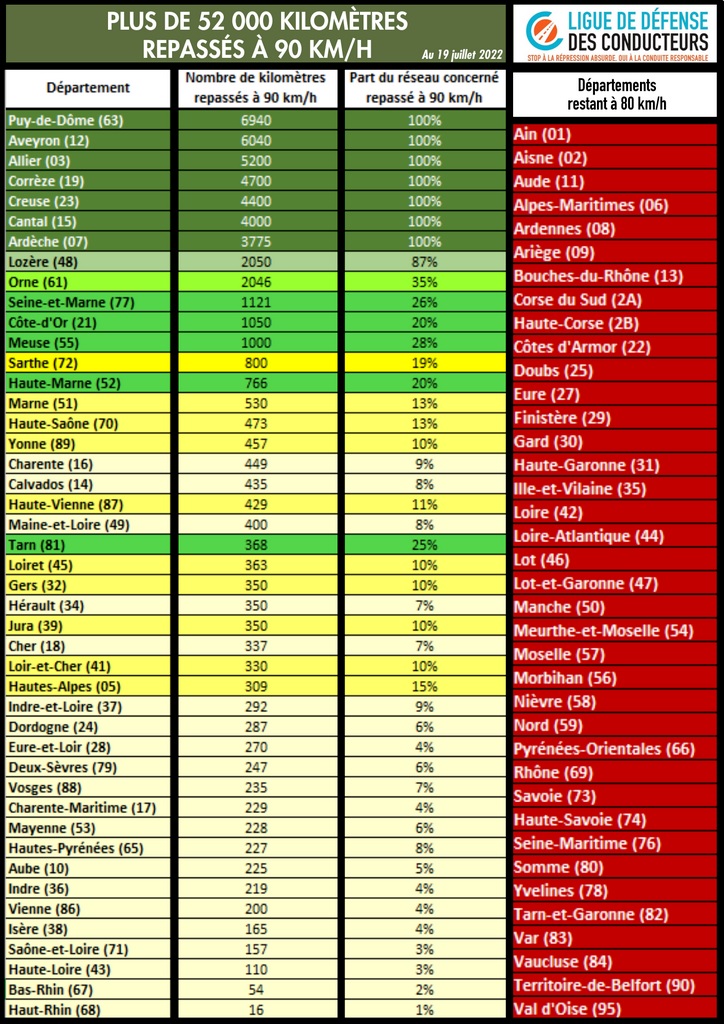
Source: Ligue de défense de conducteurs
The national road safety committee has provided slim evidence of the reduction in deaths from a lower speed limit, but other arguments are being deployed to try and keep the lid on more widespread adoption of a higher speed limit, notably the beneficial impact on the environment and the improved economies for motorists.
Related Reading: