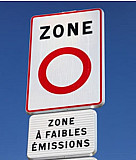

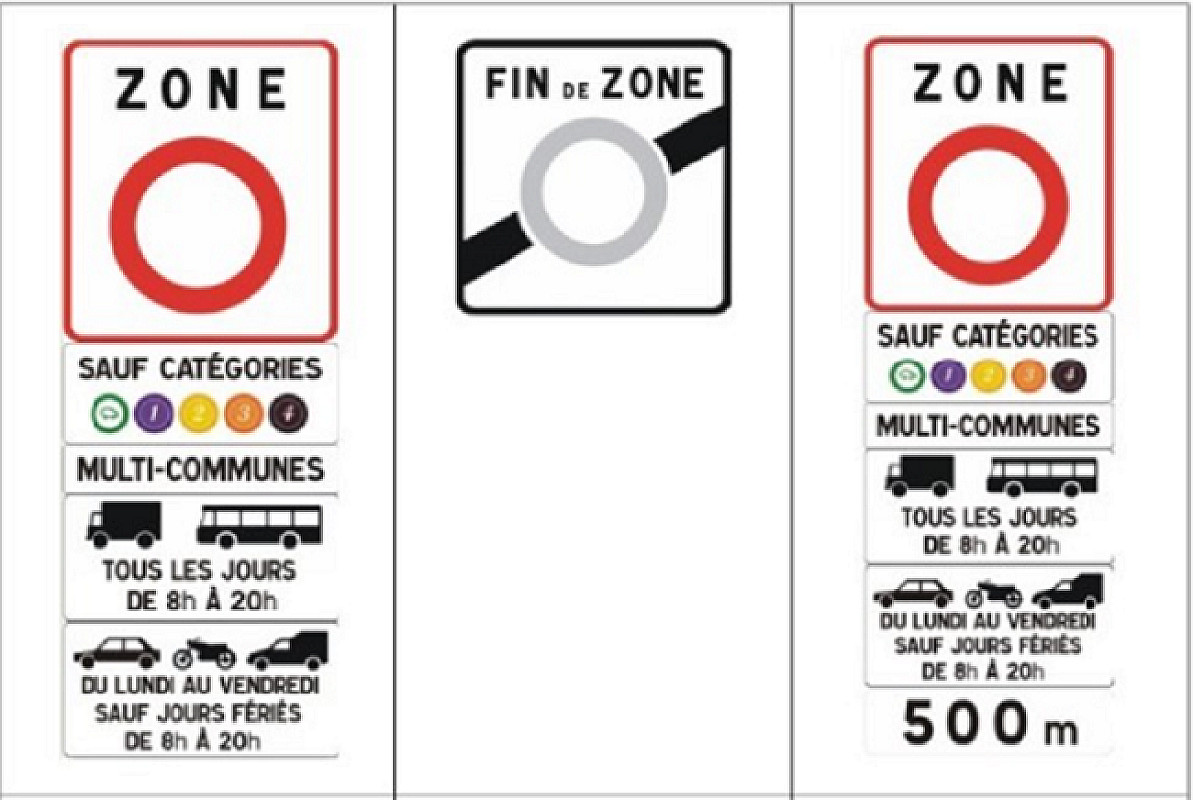
Introduced initially in several metropoles, since the beginning of this year these zones are now in operation in most urban areas with a population of at least 150,000.*
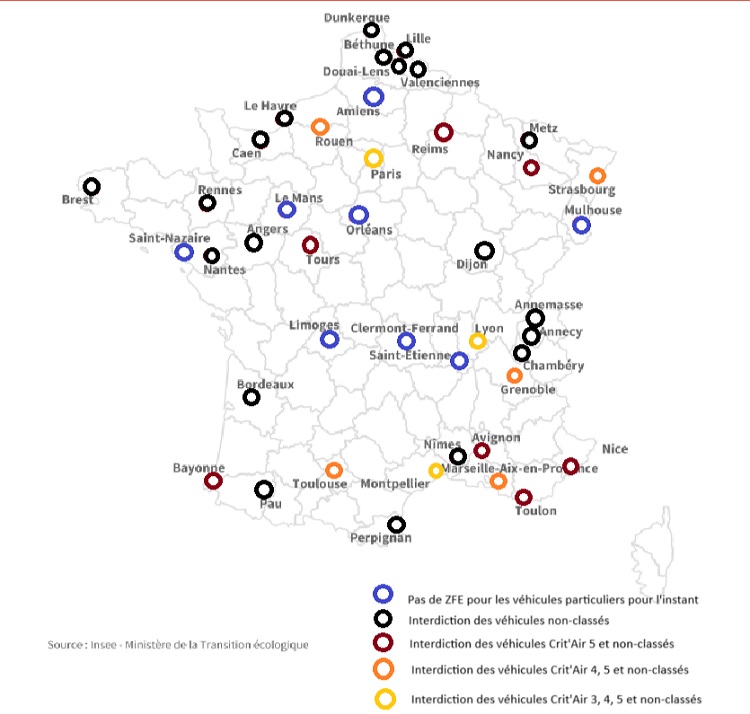
The current status of the main towns and cities in the country is shown below.
The aim of the Zone à faible émissions mobilité (ZFE-m) is to reduce air pollution, by limiting the circulation of the most polluting vehicles within a defined perimeter.
To circulate, each vehicle must have a Crit'Air sticker affixed to the windshield allowing it to be distinguished according to its level of atmospheric pollutant emissions. A sticker can be obtained on-line at Commander votre vignette Crit'Air. This is the official website (available in English) and the only one that should be used. There is a charge of €3.81.
The local town councils are responsible for implementation and enforcement of the zones, and within certain parameters they have discretion how they should operate.
As a result, the precise rules concerning the types of vehicles concerned and the times of operation of the zone differ across the country. In all cases, however, foreign vehicles are obliged to comply and have a Crit-Air sticker on the windscreen.
Since January 1, 2025, Crit'Air 3 vehicles (i.e. petrol and hybrid cars registered before 2006 and diesel vehicles registered before 2011) are no longer authorised in Paris, as well as in Lyon, Grenoble and Montpellier.
Elsewhere, although the Crit'Air sticker is now mandatory, only "unclassified" vehicles not eligible for a Crit'Air sticker, i.e. those registered before 1997 for cars and before 31st May 2000 for motorcycles and mopeds, are prohibited from driving.
In theory, failure to comply with the new requirements could lead to a fine of €68. However, this year government have encouraged the local councils to adopt a lenient approach as to enforcement of the 1st Jan changes, in order that drivers can become accustomed to them.
In addition, there are currently no radar control systems in place on entering the zones, as a result of which enforcement must be carried out by municipal officers, a herculean task. The anticipated date for installation of the radars in the principal cities is 2027.
There are several exemptions on a national basis, most notably for disabled drivers who hold a 'mobilité inclusion stationnement' card. Application must be made to the local council.
It is possible for local councils to also grant an exemption to vintage vehicles and many have done so, or are in the process of considering it. Such vehicles must be at least 30 years old, and be accepted as a ‘véhicle de collection’ by the Fédération française des véhicules d'époque (FFVE). The concession is likely to become a national one, with the creation of a specific Crit'Air sticker for registered vintage vehicles.
Not all vehicles that are at least 30 years old can be accepted, but the FFVE take a liberal view of the definition, provided it is at least 30 years old. You can read more about the process of obtaining vintage status at Owning a Vintage Car in France.
Locally, the councils are putting in place their own detailed rules. The most common of these are the operating hours and days for the ZFE. Most ZFE are not in operation at night or at weekends.
Most councils are also offering a pass that grants otherwise excluded vehicles the right to enter a ZFE for a limited number of days each year.
In addition, there are also local exemptions for those who only use their vehicle for a limited number of kilometres each year (normally no more than 10,000 kms). This is widely known as the petit rouleur exemption.
Night workers are also being offered an exemption in many areas.
Finally, there are also specific exemptions and authorisations for commercial and professional vehicles.
All of this does mean that for those who do not drive a Crit'Air 1 or 2 classed vehicle, the cartography of driving in France has just become a lot more complicated.
*The complete list of towns and cities concerned is: Paris, Lyon, Montpellier, Grenoble, Rouen, Reims, Strasbourg, Clermont-Ferrand, Nice, Aix Marseille, Saint-Etienne Toulouse, Dunkerque, Lille, Douai Lens, Valenciennes, Amiens, Metz, Nancy, Mulhouse, Dijon, Annemasse, Annecy, Chambéry, Toulon, Avignon, Nîmes, Perpignan, Pau, Bayonne, Bordeaux, Limoges, Orléans, Tours, Angers, Nantes, Le Mans, Brest, Rennes, Caen, Le Havre and Béthune.