

Income and Social Class in France
According to a 2022 study carried out by Ipsos, for the charitable body Secours populaire, 38% of French people say they are poor because they regularly deprive themselves of leisure or medical care.
However, personal perceptions of what constitutes poverty (and wealth) can be far off the mark.
In order to differentiate between the various social classes, the research body Observatoire des inégalités recently published a report that seeks to determine objectively just what constitutes rich and poor.
To be considered poor, the report argues a household should have a monthly disposable income (after taxes) below the poverty line. This, they argue, corresponds to half the national average income.
According to INSEE, the national statistical agency, the average income is €1,882 per month (2020), making the poverty line for a single person €941 per month.
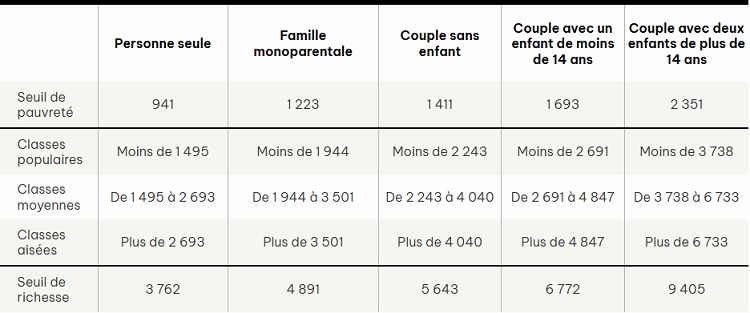
In order to determine social status by household type and size the study set income levels for 5 different household profiles - a single person, a single parent, a couple without children, a couple with 1 child under 14 and a couple with 2 children over 14.
A single person is poor if their disposable income is less than €941 per month. Up to €1,500 they belong to the class populaire and between €1,500 and €2,700 euros to the class moyenne. They are classified as class aisées above €2,700 and riches above €3,800 per month.
The poverty level for a couple without children is estimated to be €1,411, whilst for a couple with 1 child under 14 it is €1,693.
A couple would be considered rich with an income of €5,643 per month, rising to €6,772 if they had 2 children under 14 years.
The graphic below shows the 5 households and the income levels that apply, as well as those defining the 3 main social categories.
INSEE Study
In a separate recent study by INSEE the poverty level was given as 60% of the average income. This gave as poverty levels (in 2020) of €1,120 for a single person, €1,680 for a couple without children and €2,350 for a couple with 2 children under 14 years of age.
On that basis there were 14 million people living in poverty, equivalent to 14% of the population.
The study also looked at the average percentage levels of poverty across the country, which is shown on the graphic below.
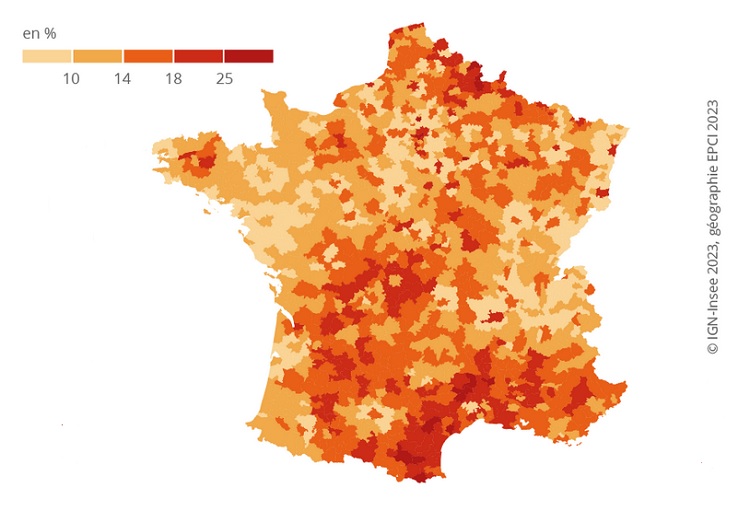
On a regional scale in mainland France, poverty is more present in Hauts-de-France, and in the southern regions of mainland France (Occitanie, Provence-Alpes-Côte d’Azur). It is less common in the west (Pays de la Loire, and Brittany). Within regions, disparities can also be significant between departments. In the Île-de-France, percentage poverty levels are highest in Seine-Saint-Denis (27.6%), while it is among the lowest in neighbouring Yvelines (9.7%).