
According to 'Sispea' (an observatory on public water and sanitation services), 20% of the water entering the distribution system is lost before it reaches the consumer.
That amounts to 480 million cubic metres of water.
Most losses occur in the cities, with the 20 largest cities responsible for nearly 25% of the volume of leaks.
The worst offender is Nice, where nearly 19 million m3 of water is lost in the network, around 25% of water in the system.
Paris looses 16 million m3, followed by Bordeaux (13.2 million m3), Montpellier (8.8 million3), Nîmes (6.2 million m3), and Rouen (5.4 million m3).
However, in percentage terms, the largest losses occur in rural communes, where in many cases half of the water entering the system is lost to nature.
A study recently published by the association of inter-municipalities of France, shows that in nearly 200 areas water leaks exceed 50% of the supply.
The worst offender was the commune of Astet in the Ardèche (Auvergne-Rhône-Alpes) with a leakage rate of 91%!
Most of the councils concerned are in mountainous areas, notably the Vosges, Hautes-Alpes, and Pyrénées-Orientales. In the metropole of Perpignan (Pyrénées-Orientales), one of the areas most affected by drought in recent years, the leakage rate is 60%.
Nearly 80% of the water authorities are run by local councils that do not belong to an intercommunal council, leading the authors to conclude (not surprisingly) that they are ill-equipped to deal with the problem.
Under central government plans, from 1st January 2026, all water services must be transferred to an intercommunal council. Some local councils are resisting the change and President Macron has shown no inclination to engage with them in a battle over it.
In March 2023 President Macron initiated a "plan eau", with a budget of €180 million to tackle the leaks, including €53 million set aside for the 170 priority municipalities to help them repair and/or modernize their infrastructure. The association of inter-communal councils considers the sum is substantially below the amount needed, saying that investment in the order of €5 billion is required.
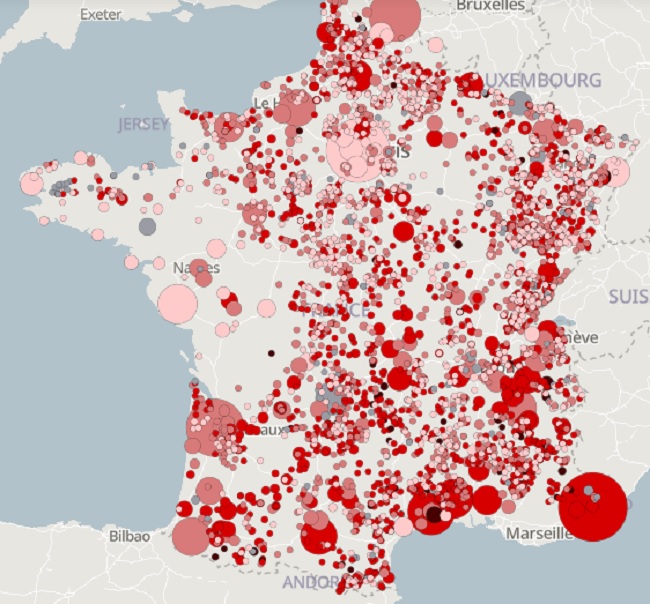
The map below shows the volume of water lost in the network in 2022, from 1m m3 to 18.9m3 in the Nice metropolitan area. In those communes coloured black the rate of leakage is greater than 100 m3/hab, whilst in light pink less than 10 m3/hab. As can be seen the west of France is relatively spared significant losses.
Advice
If you seek personalised advice on any of the issues raised in this article, you can contact our Property Clinic, and one of our advisors will get back to you.
<li><a href="https://news.france-insider.com/archive/drought-mor/"><span style="font-weight: bold;">Drought Crisis in France
<li><a href="https://news.france-insider.com/archive/water-wars-in-deux-sevres/"><span style="font-weight: bold;">Water Wars in Deux Sèvres</span></a></li>