
For small businesses, the reform initially appears intimidating. The terminology alone is a nightmare: facturation électronique, plateforme de dématérialisation partenaire (PDP), plateformes agréées, Factur-X, e-invoicing, e-reporting, and structured data formats.
In practice, however, the transition is less complicated than it may appear.
There are two principal components to it:
E-invoicing – the electronic exchange of structured invoices between businesses established in France (B2B transactions).
E-reporting – the electronic transmission to the French tax authorities of information about transactions that fall outside the domestic B2B e-invoicing system, notably sales to private individuals (B2C) and transactions with customers outside France. Certain transactions (eg those exceeding €10,000) require additional payment data reporting.
Under the new system, a B2B invoice can no longer simply be sent directly from one business to another by email as a Word or PDF document.
Instead, the invoice must be issued and transmitted through an approved electronic invoicing platform, in a prescribed format, which will also transmit the required information to the French tax authorities.
Although the government have given several laudable business reasons why the reform has been introduced, undoubtedly the most important is to reduce VAT fraud, which costs the state an estimated €8-€10 billion each year.
Phased Introduction
The reform is being introduced in two stages.
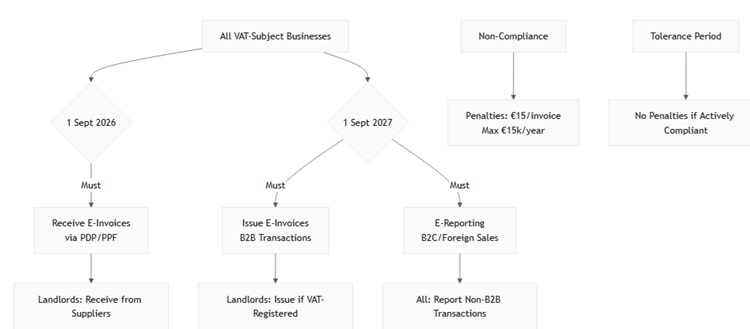
From 1st September 2026, every business subject to VAT must be able to receive electronic invoices, regardless of its size.
From 1st September 2027, all businesses, including SMEs and micro-entreprises, will be obligated to issue electronic invoices.
Small businesses are free to adopt electronic invoicing ahead of the mandatory deadline.
The graphic below shows the implementation plan.
VAT
The rules apply to businesses and self-employed people carrying on an economic activity that falls within the scope of VAT.
That does not necessarily mean that you actually charge VAT. For example, a micro-entrepreneur benefiting from the franchise en base de TVA (VAT exemption threshold) does not charge VAT, but is nevertheless regarded as being subject to VAT for the purposes of the reform and is therefore within its scope, at least in respect of receiving electronic invoices. The French tax authorities explicitly state “The reform applies to all persons subject to VAT, whether liable for VAT.”
Private Customers
If your customers are private individuals, you do not have to send them an electronic invoice through the B2B e-invoicing system.
Nevertheless, the transactions must be reported electronically to the French tax authorities. This is the e-reporting requirement.
Foreign Only Sales
The same e-reporting requirement applies to transactions with customers outside France.
So a business that sells exclusively to private individuals or foreign customers is not necessarily outside the reform. It has no B2B e-invoicing obligation on its sales, but it will have e-reporting obligations.
Clearly, if the business has both foreign and domestic B2B clients, it is caught by the e-invoicing obligations for the latter.
Platforms
There are now more than 100 platforms (all private companies) approved by the French tax authority, ranging from simple services aimed at very small businesses to sophisticated accounting platforms for larger companies.
For small businesses, one of the most widely used appears to be Indy, but a full list can be found at la liste des 101 premières plateformes agréées. The registration process is not complicated and can be done in minutes.
The platform will provide the electronic address through which the business receives invoices and can handle the transmission of invoices and e-reporting data to the tax authorities.
The business may then be able to continue to use its existing invoicing process, with the platform handling the technical conversion and transmission.
For a small business with a manual accounting system, data may be entered directly into the platform. Businesses using compatible accounting software can instead have the information integrated and transmitted automatically. The platform will convert the data into a structured format, which is then sent to the customer and the tax office.
Landlords
The French tax authorities specifically identify loueurs en meublé as a category for which the rules can require a more detailed assessment.
From 1st September 2026 you must be able to receive electronic invoices from your suppliers — energy providers, tradespeople, furniture suppliers, accountants, management agents, etc. This applies whether you are on the régime réel or régime micro.
From 1st Sept 2027, if you charge VAT on any of your services (para-hotel services) then you will be obliged to issue compliant invoice.
In the case of an SCI the obligation attaches to the SIREN of the SCI.
Compliance
As might be expected there are heavy fines potentially payable for those who do not comply, but the government has indicated there will be a period of tolerance to allow businesses to set up new accounting systems if necessary. The law also provides a right to correct a first-time breach without penalty if it is remedied within 30 days of being notified.
The government state specifically: Il est précisé que pendant la phase de démarrage, il n'y aura pas d'application des sanctions aux entreprises rencontrant des difficultés dans la mise en œuvre de la réforme mais qui sont engagées dans une trajectoire sérieuse de mise en conformité… Cette approche ne constitue ni un report ni une suspension de l’obligation.
Related Reading: